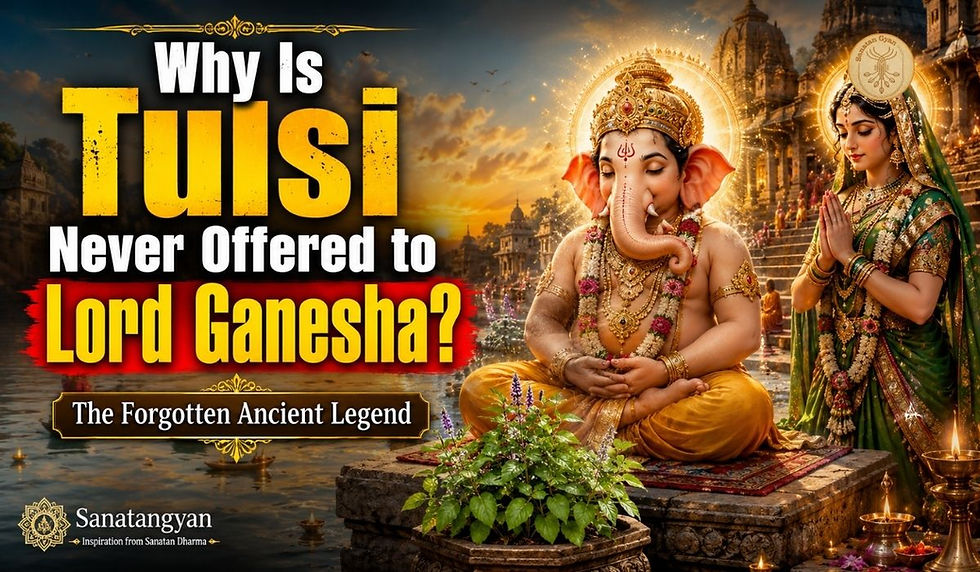
Why Is Tulsi Never Offered to Lord Ganesha? The Forgotten Ancient Legend

Ever wondered why Tulsi leaves are forbidden in Ganesha worship? Uncover the fascinating story of Tulsi Devi, Lord Ganesha, and an ancient curse that shaped Hindu rituals.
In Hinduism, Tulsi is thought to be among the most sacred plants. It is offered to many gods, but especially to Lord Vishnu and Lord Krishna. Interestingly, however, Tulsi leaves are never offered in worship by followers to Lord Ganesha, despite being one of the most commonly worshipped gods. This unusual historical tradition originates from an ancient legend involving dedication, denial, and the legacy of divine punishment. This article explores the lost legend associated with this particular Hindu tradition.
The Sacred Importance of Tulsi in Hinduism
Tulsi, or Holy Basil, has a very special place in Sanatana Dharma. Tulsi is believed to be a representative of Goddess Lakshmi (who is the eternal partner of Lord Vishnu), and is therefore a symbol of purity, devotion and spiritual power.
The Padma Purana and other scriptures have lauded the virtue of Tulsi. For example, one of the famous verses in Sanskrit reads:
तुलसीदलमात्रेण जलस्य चुलुकेन वा ।
विक्रीणीते स्वमात्मानं भक्तेभ्यो भक्तवत्सलः ॥
Lord Vishnu becomes pleased with even a single Tulsi leaf offered with devotion and grants His blessings to the devotee.
Since Tulsi has a sacred connection to Lord Vishnu, the leaves are a necessity to use during puja (worship) of Vishnu or Krishna. To this day, in many Hindu homes, Tulsi plants are lovingly grown in the courtyards and Hindu families perform daily prayers over the plants.
As often discussed on Sanatangyan, Tulsi is not just an ordinary plant, but instead, serves as a representation of divine devotion and spiritual purity.

Why Is Lord Ganesha Worshipped First?
Before exploring the legend, an understanding of who Lord Ganesha is will help put things into perspective.
Many Hindus know Lord Ganesh, who is called the Vighnaharta (the one who removes obstacles) and Siddhidata (the one who gives success), and worship him daily as part of their religious practice. There is no Hindu ceremony, ritual, or auspicious event that does not begin with the asking of Lord Ganesh’s blessing.
The famous Sanskrit verse states:
वक्रतुण्ड महाकाय सूर्यकोटि समप्रभ।
निर्विघ्नं कुरु मे देव सर्वकार्येषु सर्वदा॥
“O Lord with the curved trunk and mighty form, whose brilliance equals millions of suns, please remove all obstacles from all endeavors.”
Students look for wisdom in Lord Ganesh, business owners pray for success and all who devote their life to Lord Ganesh do so for prosperity and guidance.
With so much reverence between Tulsi and Lord Ganesh, why is it that Tulsi leaves cannot be offered to Him?

The Forgotten Ancient Legend of Tulsi and Ganesha
The Brahma Vaivarta Purana holds the reason behind this mystery within the story of Tulsi Devi and Lord Ganesh.
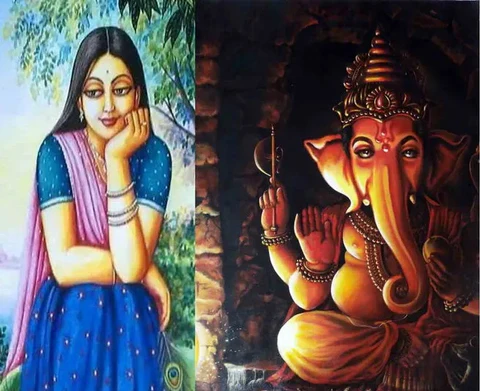
One time, the great Lord Ganesh was meditating on the bank of the holy Ganges River, when he was approached by Tulsi Devi, a beautiful princess and devoted ascetic.
When Tulsi saw Lord Ganesh’s brilliant form, she fell in love with him and expressed to him her desire for marriage.
However, Lord Ganesh was devoted to the study of spiritual disciplines and did not marry at the moment. He respectfully rejected Tulsi’s proposal.
Tulsi was heartbroken and angry, so she cursed Lord Ganesh and told Him that one day he would have to marry.
With regards to his curse, Tulsi’s reaction was the same and he responded with a similar work of a curse; thus he similarly named when Tulsi would marry a demon first, and then Tulsi will become a holy plant transformed afterwards.
Unfortunately, as it comes out, both of them ended up realising what had happened to them both through their curses towards each other. Before Lord Ganesha inspired himself to shorten his curse to Tulsi, he blessed her with one of the highest plants and sacred plant on the planet and that she would be extremely loved by Lord Vishnu for all time.
However, he also declared that her leaves would never be accepted in his worship.
The history of the above has been handed down in the stories from generation to generation in most Hindu communities; today, the history of how millions of Hindus continue to uphold this fact is based on this story.
Scriptural and Symbolic Interpretations
Beyond the legend, many scholars offer symbolic interpretations of this practice.
Because Tulsi holds a close association with both Goddesses Lakshmi and Vishnu, it is expected that only leaves of Tulsi will be offered to Vishnu, Krishna and their incarnations as part of the traditional aspects of the relationship between Tulsi and Vishnu exist there.
The story of Tulsi being married to a demon is understood to carry with it a message regarding self-discipline, respect and the result of being too hasty to make a decision. Although Lord Ganesha was too spiritually disciplined to have an attitude of self-discipline and thereby refused to be married to a demon, the result of Tulsi's anger was to trigger a series of events that resulted in the resurrection of Tulsi.
Most Hindu traditions utilise the stories of these incidents as vehicles for teaching deeper spiritual truths, rather than for their history and past. This aspect is stated in the many discussions found in the new age Hindu culture of Sanatangyan.

Are There Any Exceptions?
While a few regional customs make an exception during special occasions, the overall trend is still not offering Tulsi leaves to Lord Ganesha by most Hindu temples and by most Hindus.
Instead, devotees offer durva grass, which is considered extremely dear to Ganesha.
According to the Ganapati Atharvashirsha, not only is Lord Ganesha great, but he also has his own unique worship methods and offerings from other deities according to their respective traditions.
The reason behind devotees’ reluctance to offer Tulsi to Lord Ganesha originates with an ancient story and has a profound spiritual impact. Many sadhus, gurus and shastras inform us that we have than one method for each deity, so when devotees honour these traditions sincerely, they gain greater faith and a greater understanding of the treasures of wisdom contained in Sanatana Dharma.

Comments