Why Is Lord Ganesha Shown Sitting in Different Ways? Know the Meaning Behind Each Posture

Why does Ganesha sit with one leg folded? What does the raised hand or trunk direction mean? Discover the deeper symbolism behind every posture.
Celebration of Ganesh Chaturthi 2026 will commence from Monday, September 14, when Bappa enters the household and pandals to usher in the festival of devotion, colour, and festivities. But have you ever thought why Lord Ganesha seems to sit in various positions in various idol statues? Be it the direction of his trunk, legs, mudras, lotus, or even modak, all of them are meant to carry some significance. So, before celebrating with Bappa in the coming festive season, let us explore what do these symbols mean for sanatangyan.

Why Does Lord Ganesha Have Different Postures?
The iconography of Ganesh has evolved over years of Hindu art and worship, with āsanas (seated posture) depicting different qualities of him. Classical Indian iconography recognises several divine sitting positions, including Padmasana, Dhyana and Ardhaparyanka, also associated with royal ease.
The deeper message is beautifully reflected in the Ganesha Atharvashirsha:
त्वं ज्ञानमयो विज्ञानमयोऽसि।
“You are the embodiment of knowledge and wisdom.”
This is the essence behind Ganesha's form. The idol becomes a visual reminder that outer prosperity is meaningful when guided by wisdom.
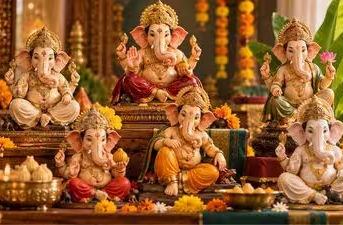
Ganesha With the Right Hand Raised: Blessing and Fearlessness
When Ganesha raises a palm outward, the gesture is commonly understood as Abhaya Mudra, associated with protection, reassurance and fearlessness.
The message is simple: fear need not control the journey ahead.
This form can therefore feel especially meaningful during new beginnings such as a housewarming, wedding, new business, examination or important spiritual undertaking. The raised palm visually communicates courage, protection and divine reassurance.
In Sanatangyan, the symbolism of this mudra suggests that eliminating obstacles does not necessarily mean getting rid of everything but acquiring the strength to face them.
Ganesha Holding a Modak: The Sweetness of Wisdom
The modak in Ganesha's hand is far more than a favourite sweet.
Traditionally, the modak represents the sweetness of spiritual knowledge and the fruits of disciplined effort. Its outer covering and sweet filling can also be viewed as a reminder that deeper wisdom is discovered by going beyond the surface.
The Ganapati Atharvashirsha specifically mentions modakas in its worship:
यो मोदकसहस्रेण यजति स वाञ्छितफलमवाप्नोति।
“One who worships with a thousand modakas obtains the desired fruit.”
This does not simply make the modak a symbol of material reward. In devotional tradition, it connects the offering with fulfilment and the fruits of sincere worship.
Explore Further: Ganesh Chaturthi 2026: Bappa Is Coming! Check Tithi, Sthapana Muhurat, Puja Time & Visarjan
Trunk Direction: Left, Right or Straight?
The direction of Ganesha's trunk is one of the most discussed aspects of his iconography.
A left-curving trunk is traditionally associated in some worship traditions with the lunar or Chandra channel and a gentler household form. A right-curving trunk is associated with the solar or Surya channel and is traditionally considered more demanding in ritual practice.
However, this should not be treated as a universal scriptural rule.
Classical iconographic traditions classify Ganesha through different named forms and characteristics, while modern devotional traditions may attach specific meanings to trunk direction.
A straight trunk is often interpreted symbolically as balance and centred awareness.
Hence, picking out a Ganesha statue should be based on traditions and knowledge and devotion rather than fear.
Sitting With One Leg Folded: Spirituality Meets Duty
Some Ganesha statues have one leg folded and the other leg slightly lowered and closer to the ground. Such posture is a symbol of harmony between self-reflection and involvement in the world.
The folding of the leg is symbolic of self-reflection, discipline and focusing inward. The lowering of the leg is a sign of active participation in the affairs of the world.
Such postures express an important principle of Sanatan: spiritual development does not mean renouncing worldly affairs. One may be busy in their life and still keep consciousness centred.
Explore This Topic Further: Hartalika Teej 2026: Why Is This Teej Special? Check Shubh Yogas, Puja Muhurat & Paran Time
Ganesha Holding a Lotus: Rising Above Attachments
The lotus is also a very meaningful symbol which represents purification and enlightenment.
A lotus grows from the mud and rises out of it but remains unsoiled. This symbol can mean that one may stay in touch with the world but not become obsessed with it.
This form of Ganesh can be especially significant in corners for meditation, studying or doing yoga.
The symbolism is clear, yet profound - to rise above the surroundings without sacrificing purity inside oneself.

Finally, the symbolism of each Ganesha pose is wonderful spiritual teaching of wisdom, bravery, harmony, and wealth. The knowledge of symbols gives an even greater meaning to the presence of Bappa during Ganesh Chaturthi.

Comments