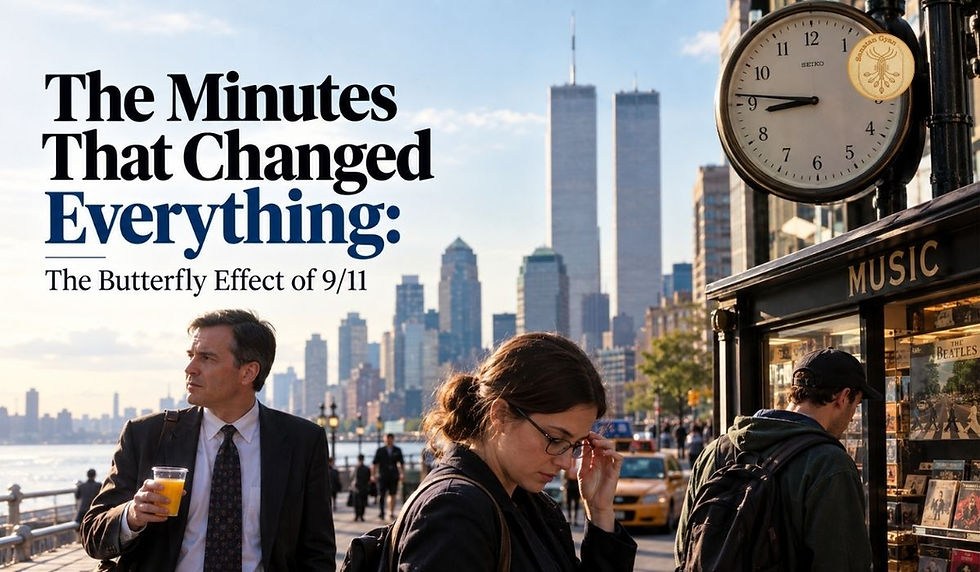
The Minutes That Changed Everything: The Butterfly Effect of 9/11

Did ordinary delays save lives on 9/11? Explore the powerful stories that raise questions about coincidence, fate and the butterfly effect.
A delayed meeting, a quick drink, repaired glasses or an unexpected stop at a music store—on September 11, 2001, seemingly ordinary minutes changed the course of several lives. These remarkable survival stories raise difficult questions about coincidence, fate and the butterfly effect, while reminding us how little control anyone has over tomorrow.
9/11: Remembering the Day That Changed the World
September 11, 2001, remains one of the darkest days in modern history. The terrorist attacks killed 2,977 people at the World Trade Center, the Pentagon and near Shanksville, Pennsylvania. The official 9/11 Memorial continues to honor every person killed that day.
The story of 9/11, however, also includes people who were expected to be inside the World Trade Center but, for one unexpected reason or another, were somewhere else when the attacks began.
At 8:46 a.m., American Airlines Flight 11 struck the North Tower. At 9:03 a.m., United Airlines Flight 175 hit the South Tower. Within those few minutes, countless ordinary morning routines became life-changing turning points.

The Small Delays That Became Life-Changing
David Kravette, who worked for Cantor Fitzgerald in the North Tower, was normally expected to be at his desk high above the city by 8:46 a.m., when American Airlines Flight 11 struck the building. That morning, however, he was running a few minutes late after stopping in the lobby for a cup of orange juice.
Chef Michael Lomonaco has an equally extraordinary story. He was the executive chef of Windows on the World, the restaurant at the top of the North Tower. Instead of immediately going upstairs, he stopped at an optician in the World Trade Center concourse to have his glasses adjusted.
At 8:46 a.m., while Lomonaco was still on the ground floor, Flight 11 hit the North Tower. He survived, while dozens of his colleagues and guests at Windows on the World did not.
Another remarkable survival story belongs to Sara Botkin. On that morning, she made a spontaneous decision to buy a signed Mariah Carey CD. The purchase delayed her journey toward her workplace in the South Tower. When the attack began, she was still on the ground floor and was able to escape.
A decision that might normally have been forgotten became a permanent part of her life story.
Explore Further: Why Is Lord Ganesha Shown Sitting in Different Ways? Know the Meaning Behind Each Posture
What Does the Butterfly Effect Really Mean?
The phrase “butterfly effect” comes from chaos theory, not spirituality. Meteorologist Edward Lorenz famously discussed the idea in a 1972 scientific presentation about how tiny changes in initial conditions can produce dramatically different outcomes in complex systems.
Human life is obviously not a weather equation. A delay does not scientifically prove that the universe was protecting someone. There is also no reliable number showing how many people survived 9/11 specifically because they were late.
That distinction matters.
The butterfly effect works here as a powerful metaphor: small choices can sometimes lead to consequences far larger than anyone could imagine.
A five-minute delay can change where someone is standing. A postponed meeting can change a person's entire day. A decision to stop somewhere can alter the next few minutes—and sometimes, the rest of a life.
Explore This Topic Further: September 14 Special: Hartalika Teej & Ganesh Chaturthi—Which Puja Comes First?
Fate, Coincidence or Something More?
From a spiritual perspective, such stories can encourage reflection without requiring a definite answer.
The Bhagavad Gita says:
“कर्मण्येवाधिकारस्ते मा फलेषु कदाचन।”
Meaning: One has control over action, but not over the fruits of action.
The verse does not say that every event has a predetermined explanation. Instead, it highlights a truth that remains deeply relevant:
people can make choices, but the complete consequences of those choices are rarely visible.
That is perhaps what makes these 9/11 stories so moving. The people involved were not consciously making “life-saving” decisions. They were simply living an ordinary morning.

Comments