Snana Purnima 2026: The Hidden Mystery Behind Lord Jagannath's Sacred Bath

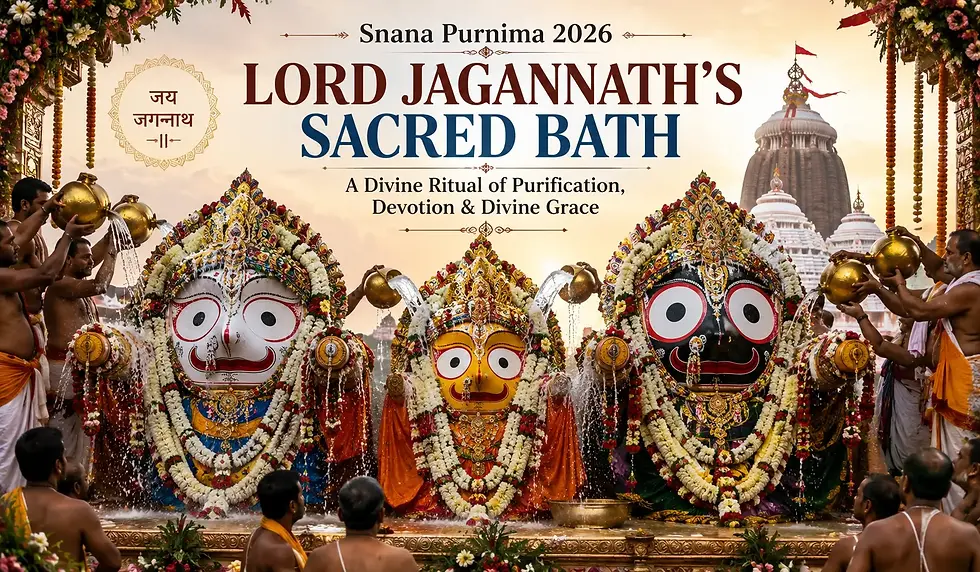
Every year, before the world-famous Rath Yatra begins, devotees eagerly celebrate Snana Purnima, one of the most sacred festivals dedicated to Lord Jagannath. At first glance, it may look like a grand bathing ceremony, but its spiritual meaning goes much deeper. It is a beautiful reminder that God is not distant from His devotees. Instead, He comes closer to them, accepts their love, and teaches valuable life lessons through His divine pastimes.
Snana Purnima marks the beginning of the spiritual journey that eventually leads to Rath Yatra. It is the day when Lord Jagannath, Lord Balabhadra, and Devi Subhadra appear before thousands of devotees for their annual ceremonial bath.
What Is Snana Purnima?
Snana Purnima is one of the most sacred festivals in the Jagannath tradition and marks the beginning of the spiritual celebrations leading up to the famous Rath Yatra. It is observed on the Purnima (Full Moon) Tithi of the Hindu month of Jyeshtha, when Lord Jagannath, Lord Balabhadra, and Devi Subhadra are ceremonially bathed in a grand public ritual.
In 2026, Snana Purnima will be celebrated on Monday, June 29. On this auspicious day, the three deities are brought out from the sanctum of the Jagannath Temple in Puri and placed on the Snana Mandapa, a beautifully decorated bathing platform. Priests then perform the sacred Maha Snana (holy bath) using 108 pots of sanctified water drawn from the temple's sacred well.
In Sanatan Dharma, the number 108 holds deep spiritual significance. It symbolizes completeness, divine consciousness, and the eternal connection between the individual soul (Atman) and the Supreme (Paramatma). The ceremonial bath is not just a ritual—it represents the purification of the mind and heart, reminding devotees to cleanse themselves of ego, anger, and negativity before embarking on the spiritual journey of Rath Yatra.
Why Is the Sacred Bath So Important?
The bathing ceremony is not performed simply to decorate the deities. It carries a profound spiritual message.
Just as water cleanses the body, devotion cleanses the mind. Snana Purnima reminds us that while physical cleanliness is important, inner purity is even more valuable. Feelings like anger, pride, jealousy, and greed can only be washed away through sincere prayer, selfless service, and devotion to God.
The festival encourages every devotee to begin a new spiritual journey with a pure heart.
The Beautiful Story Behind Gaja Vesha

After the sacred bath, Lord Jagannath and Lord Balabhadra are dressed in the unique Gaja Vesha, also known as the Elephant Form. This tradition has a touching story behind it.
According to temple tradition, there was once a devoted worshipper of Lord Ganesha named Ganapati Bhatt. He travelled to Puri with great faith but felt disappointed because he could not see his beloved Ganesha in Lord Jagannath.
Seeing the sincerity of His devotee's heart, Lord Jagannath appeared in the form of an elephant. This divine appearance became known as Gaja Vesha.
The story teaches a powerful lesson. God does not look at our external identity or preferred form of worship. He responds only to pure devotion. Whether someone worships Shiva, Vishnu, Ganesha, or Devi with complete faith, all sincere devotion ultimately reaches the same Supreme Reality.
Why Does Lord Jagannath Fall Ill?
One of the most unique traditions begins immediately after Snana Purnima.
After receiving the ceremonial bath with 108 pots of cold water, Lord Jagannath is believed to develop a fever. The deities are then taken to a private chamber where they remain away from public darshan for about fifteen days. This period is known as Anasara.

During these days, special herbal medicines, fruits, and light food are offered to the Lord as part of His recovery. Although the Lord is beyond birth, disease, and death, He performs this divine pastime to strengthen His loving relationship with devotees.
This reminds us that God willingly shares human experiences to make His presence feel personal and compassionate.
The Return Before Rath Yatra
After the Anasara period ends, Lord Jagannath appears once again in a youthful and radiant form during Nava Jaubana Darshan. Devotees eagerly wait for this first glimpse because it marks the Lord's recovery and prepares everyone for the grand Rath Yatra.
Soon after, Lord Jagannath, Lord Balabhadra, and Devi Subhadra begin their divine journey on magnificent chariots, blessing millions of devotees gathered from around the world.

Snana Purnima is much more than a temple festival. It teaches timeless values that are relevant even today.
The festival reminds us to cleanse not only our body but also our thoughts. It shows that humility is greater than pride and that sincere devotion is more valuable than expensive offerings. It also teaches that God listens to every devotee with equal love, regardless of caste, status, or background.
The story of Gaja Vesha reminds us that the Divine accepts every genuine path of devotion. What truly matters is the purity of our heart.
पत्रं पुष्पं फलं तोयं यो मे भक्त्या प्रयच्छति।
तदहं भक्त्युपहृतमश्नामि प्रयतात्मनः॥ (Bhagavad Gita 9.26)
Meaning: "Whoever offers Me a leaf, a flower, a fruit, or even water with pure devotion, I lovingly accept that offering."
Snana Purnima 2026: Conclusion
Snana Purnima is not just the beginning of Rath Yatra—it is the beginning of inner transformation. The sacred bath symbolizes the cleansing of our heart, Gaja Vesha teaches that God appears in whatever form inspires true faith, and the Anasara period reminds us that the Lord lovingly shares the emotions and experiences of His devotees.
Before Lord Jagannath steps onto His magnificent chariot, He first teaches us the importance of humility, purity, compassion, and unconditional love. That is why Snana Purnima is not merely a festival—it is a spiritual invitation to prepare our hearts before beginning the journey toward God.


Comments