Prabhupada’s Prophecies on World War III: Can Humanity Change Fate?

How do Prabhupada’s prophecies guide us through the threats of nuclear war and global conflict?

The question of nuclear war has long fascinated scholars, devotees, and global thinkers. Srila Prabhupada, the founder of ISKCON, spoke about the possibility of a world-destroying conflict. His statements, often referred to as Prabhupada’s prophecies, have been interpreted in many ways. Some see them as warnings. Others see them as inevitabilities. A careful study reveals a more nuanced truth.
Prabhupada was deeply aware of the dangers posed by nuclear weapons. He lived through the Cold War, a time of extreme tension between superpowers. He observed the growing arms race and the potential for human self-destruction. His warnings were serious. He instructed temple leaders to be prepared for hardships. But he never gave a fixed date or told devotees to desire war.
Understanding Prabhupada’s Prophecies
To interpret Prabhupada’s statements correctly, we must understand how prophecy works in Vedic tradition. Not all predictions are fixed. Some are conditional. Some reflect patterns rather than absolute outcomes.
Three categories of prophecy are especially relevant:
Inevitable (Avashyambhavi): Events that will occur regardless of human action. For example, the decline of dharma in Kali-yuga.
Conditional (Yadi–Tadi): Events that can change depending on human actions or spiritual influence. Nuclear war falls into this category.
Human-projected (Kalpita): Predictions based on human estimation of trends. Dates like “2035” are projections, not divine guarantees.
Prabhupada often spoke about nuclear war in the conditional sense. He warned that humanity could bring catastrophe upon itself. But he also implied that human behavior, devotion, and spiritual awareness could alter the outcome.

Historical Context: The Cold War and India–Pakistan
Many of Prabhupada’s statements reference India and Pakistan. At first glance, this appears to be a literal prediction of conflict. However, it is more symbolic than specific.
India and Pakistan represent a civilizational fault line. Their tension highlights the consequences of divided consciousness and religious conflict. Prabhupada used this example to emphasize the fragility of materialistic civilization. He warned that without dharmic guidance, humanity could spiral toward destruction.
During the 1970s, nuclear war seemed almost inevitable. Superpowers maintained large arsenals, and miscommunication could have triggered disaster. Yet it did not occur. Prabhupada explained this by saying, “Kṛṣṇa changed His mind.” In other words, divine intervention can delay or redirect events if humanity acts wisely.
World War III: Pattern, Not Prediction
Some modern devotees and commentators link Prabhupada’s statements to what they call World War 2035. It is important to note that Prabhupada never mentioned a specific year. Such timelines are human projections. They represent patterns in geopolitics and technological development, not divine prophecy.
Global factors suggest that humanity faces increasing risks:
Multipolar nuclear powers and rising tensions.
AI-driven military technology.
Resource scarcity, including water, food, and energy.
Moral and leadership collapse in major nations.
From a Vedic perspective, these align with Kali-yuga acceleration. This era is marked by arrogance, dishonesty, and misuse of power. Prabhupada warned that without spiritual guidance, humanity could create catastrophic conditions.
However, conditional prophecy means the future is not fixed. Devotional activity, ethical leadership, and collective spiritual awareness can influence outcomes. Humanity is not powerless. The trajectory toward war can be altered.

The Misinterpretation of Prabhupada’s Warnings
A dangerous misunderstanding exists among some devotees. They assume that a global catastrophe is necessary for the growth of Kṛṣṇa consciousness. This is a misreading of Prabhupada’s prophecies.
Historical evidence shows that suffering does not automatically produce spiritual progress. The pandemic of 2020 disrupted programs and caused disputes among devotees. Wars and crises often create fragmentation, not unity. Even in cases where some communities remained strong, large-scale spiritual revival from catastrophe is rare.
Prabhupada never suggested that devotees should wait for destruction. His instructions focused on preparation, personal purification, and spiritual service. He emphasized building consciousness now rather than hoping for opportunities arising from disaster.
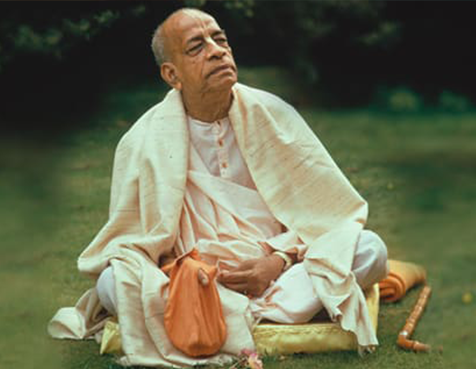
What Prabhupada Wanted to Showcase
Prabhupada’s prophecies were not merely warnings. They carried deeper lessons:
Humanity’s choices matter: Our actions determine whether calamity occurs.
Spiritual preparedness is crucial: Devotees must cultivate consciousness before crises strike.
Bhakti is independent of material conditions: Kṛṣṇa consciousness can grow in peace and stability.
Divine intervention is real: God can alter the course of history if devotion and karma allow it.
In essence, Prabhupada’s teachings were tools to awaken responsibility. He did not glorify fear. He did not claim inevitability. He wanted humanity to see the consequences of material mismanagement and embrace spiritual life.
Inevitable and Conditional Outcomes
Based on Prabhupada’s prophecies and Vedic analysis, we can separate outcomes:
Inevitable outcomes:
Decline of dharmic values in society.
Materialistic excess and environmental degradation.
Recurrent conflicts due to human arrogance.
Conditional outcomes:
Nuclear war or global conflict.
Severity of natural and man-made disasters.
Spiritual revival based on collective action and bhakti.
Speculative projections:
World War III in a specific year (e.g., 2035).
The exact sequence of conflicts between specific nations.
Understanding this distinction prevents unnecessary fear and encourages practical spiritual action.
Can Humanity Change Fate?
Srila Prabhupada repeatedly emphasized that while the material world is full of dangers, including the possibility of nuclear war, humanity is not helpless. He taught that the course of events is conditional, influenced by both karma and spiritual effort. In his discourses, he stressed that individuals cultivating Kṛṣṇa consciousness can reduce collective negativity, because consciousness is contagious: spiritually aware people inspire ethical behavior and compassion in their communities.

Similarly, he highlighted the importance of ethical leadership, where rulers and decision-makers guided by dharmic principles are less likely to initiate self-destructive conflicts. Devotees and spiritual organizations, according to Prabhupada, can act as stabilizing forces, offering humanitarian support, maintaining moral standards, and promoting unity during crises.
On a larger scale, he pointed to the power of global consciousness, cooperation, nonviolence, and dedication to higher principles as a way to mitigate tensions before they escalate into war. In essence, Prabhupada’s teachings imply that Kṛṣṇa devotion is not only personal salvation but a safeguard for civilization; through collective spiritual practice, society can be guided away from the path of destruction.
Nuclear conflict and World War III are thus not predetermined; they can be delayed, mitigated, or entirely avoided if humanity embraces devotion, dharmic values, and moral responsibility, illustrating that spiritual effort is a tangible force capable of altering even the most destructive trajectories.

Conclusion: Lessons from Prabhupada’s Prophecies
Srila Prabhupada’s prophecies on nuclear war and potential global conflict are warnings, not fixed outcomes. They highlight the fragility of human civilization and the dangers of unchecked technological and political power. They are conditional, emphasizing that spiritual awareness and ethical behavior can change destiny.
The narrative of World War III, or the projected World War 2035, should be understood as a pattern alert, not a fixed date. Humanity still has the power to change its fate through wisdom, compassion, and devotion.
Prabhupada’s ultimate message was clear:
Prepare spiritually. Act responsibly. Spread Kṛṣṇa consciousness. Avoid waiting for destruction to create opportunity. The fate of the world is in our hands, but divine guidance remains available to those who seek it sincerely.
Prabhupada’s prophecies are not about fear. They are about awakening. They remind humanity that time, technology, and power are secondary to consciousness, devotion, and ethical action.


Comments