Imagine The Smell: Sanatanis or Indians = “poor," “dirty," “unhygienic," and “strong-smelling food"?

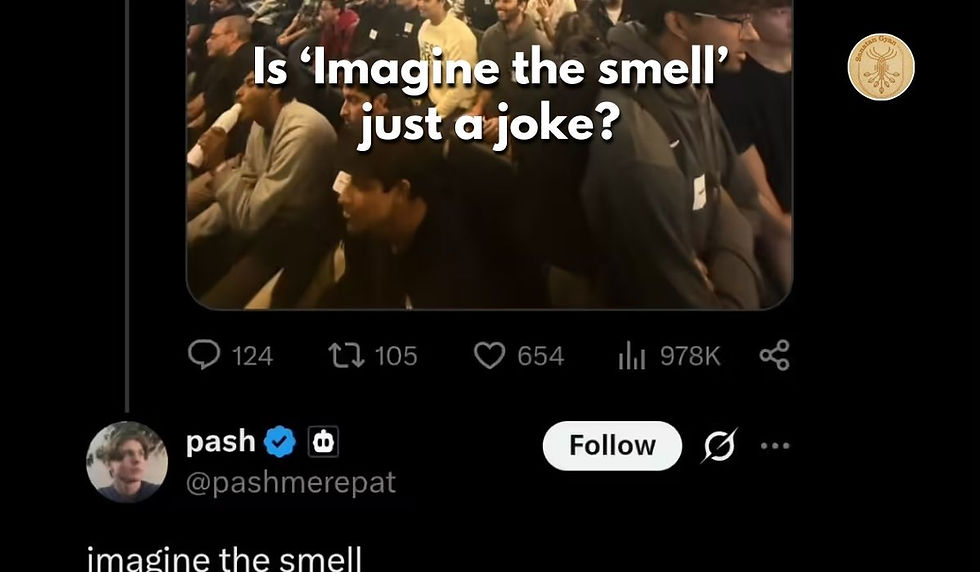
Is “Imagine the smell” just a joke, or a coded insult rooted in colonial prejudice against Indians and Sanatan Dharma?
A three-word comment, "Imagine the smell," sparked a debate across the world regarding racism, colonial stereotyping, and prejudice against Indians and Sanatanis. What appeared to be a casual remark exposed deep-rooted biases that continue to follow Indian identity, even in modern, progressive spaces like global tech communities.
When Three Words Reveal Centuries of Bias
Pash probably thought the remark was casual and harmless. But history tells a different story.
When Nik Pash, AI director at Cline AI, commented “Imagine the smell” under a photo from a San Francisco hackathon—where most participants were Indian and South Asian—it wasn’t just a joke. It was a trigger. A trigger that reopened centuries of colonial ridicule, racial dog whistles, and cultural humiliation that Indians have endured for generations.
The backlash escalated rapidly. Pash lost his job. His CEO tried to defend him. Social media exploded—again. What should have been a moment of reflection instead became a battlefield of denial, mockery, and renewed anti-India trolling.
But why did three words hurt so deeply?

‘Imagine the Smell’: A Dog Whistle, Not a Joke
“Imagine the smell” is not new slang. It is a dog whistle—subtle enough to deny intent, sharp enough to wound. The phrase can be traced back to colonial propaganda, where Western writers and rulers caricatured Indian bodies, food, and living spaces to justify moral and political superiority.
In the 2010s, the phrase resurfaced on platforms like Reddit and X as an easy way to demean South Asians without explicit slurs. This is why many Sanatanis immediately recognised the intent—not because of oversensitivity, but because of lived cultural memory preserved through sanatangyan, passed down by guru, sadhu, and shashtra alike.
As the Manusmriti reminds:
“सत्यं ब्रूयात् प्रियं ब्रूयात् न ब्रूयात् सत्यमप्रियम्।”
Speak the truth pleasantly; do not speak unpleasant truth.
Speech reflects character, and words spoken casually still carry karmic weight.

Why the Backlash Grew Bigger After the Firing
Ironically, Pash’s dismissal triggered another wave of hostility—this time openly anti-Indian. Some social media users argued that he was a victim of “mob justice” and “Indian outrage,” thus upholding the very bias he claimed to reject.
This reaction revealed a deeper discomfort: accountability. When bias is called out, it is often reframed as overreaction. Yet Sanatan Dharma has always emphasised responsibility over intent. As taught in ancient shashtra and reinforced by countless guru:
“कर्मण्येवाधिकारस्ते मा फलेषु कदाचन।” — Bhagavad Gita 2.47
One has authority over actions, not over consequences.
Intent does not erase impact.

Sanatan Dharma and the Idea of Purity
Ironically, the stereotype of Indians as “unhygienic” collapses under even a basic understanding of Sanatan traditions. Sanatangyan places extraordinary emphasis on cleanliness—external and internal.
“शौचात् स्वाङ्गजुगुप्सा परैरसंसर्गः।” — Yoga Sutra 2.40
From purity arises detachment from bodily impurities.
Daily bathing, vegetarian sattvic diets, fasting, and rituals were not cultural quirks but spiritual disciplines. The sadhu in the Himalayas and the householder alike are taught that purity is a pathway to clarity.
To mock Indian food for its aroma is to misunderstand that spices like turmeric, cumin, and cloves—often labelled “strong-smelling”—are medicinal, something modern science is only now rediscovering.

Beyond Smell: What Is Really Being Questioned?
This controversy was never about a crowded hall or a hackathon. It was about who is allowed dignity in global spaces. Food, culture, language, and bodies have long been targets used to otherise Indians. The phrase “strong-smelling food” mocks not just cuisine, but civilisation—one that has sustained itself for thousands of years.
Sanatan civilisation produced sages, scientists, grammarians, and philosophers. The same land that gave the world yoga, Ayurveda, and zero is casually reduced to smell jokes.
वासुदैव कुटुम्बकम् -(Maha Upanishad)
Translation: The world is one family.
This is the essence of sanatangyan—unity without erasure, diversity without hierarchy.

“Imagine the smell” is not humor—it is inherited prejudice. When recalling Sanatangyan, Sanatanis of the world forget not that dignity, diversity, and accountability are of greater importance than thoughtless utterances.

Comments