How Adi Shankaracharya Saved Hinduism? The Forgotten Story of an 8-Year-Old Monk
- Chinmayi Devi Dasi

- Dec 10, 2025
- 5 min read
How Adi Shankaracharya Saved Hinduism? Discover the forgotten story of a young monk who revived Vedanta, rebuilt temples, and restored India’s spiritual identity.

During one of the most pivotal moments in Indian history, when the ideas of Buddhism and Jainism were spreading across the subcontinent, a young boy from Kerala entered the world of spiritual debates and reshaped the destiny of an entire civilization. This boy was Adi Shankaracharya. Today, we discuss leaders, influencers, gurus, and motivational speakers. But more than a thousand years ago, a child monk became the silent savior of Sanatana Dharma.
A Child Who Carried the Weight of a Civilization
Adi Shankaracharya was a philosopher, born in Kalady, Kerala around 788 CE, he mastered the Vedas and Upanishads as a child and accepted sannyasa at a very young age, at 8. In a time when Buddhism and Jainism were at their peak and Vedic traditions were fading, Shankara traveled from village to village, debating scholars, awakening lost knowledge, and re-establishing the original wisdom of Advaita Vedanta. From childhood, Shankara’s mind was filled with questions that most adults never even think to ask-
What is the Self?
What is the truth behind this world?
Is life actually temporary, or is there something eternal behind it?
His brilliance was in experiencing the truth they pointed to. He chose sannyasa at a very young age and walked away from home because he wanted to understand the source of the world. That decision shaped the entire future of Hinduism.
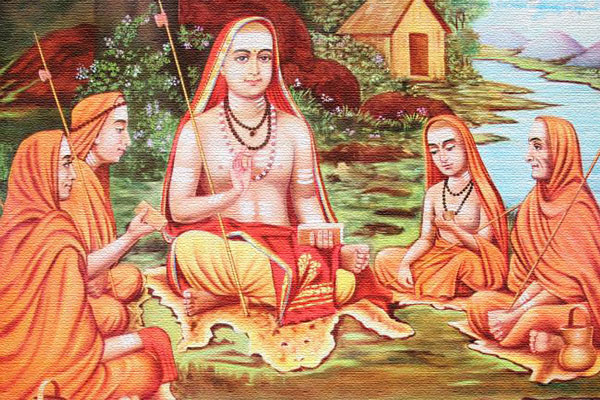
How Adi Shankaracharya Saved Hinduism
Many people do not understand what India looked like during Shankara’s time. Buddhism and Jainism were powerful. New philosophies were rising. Many Hindu rituals seemed complex, misunderstood, or even corrupted. The spiritual heart of the Vedic tradition was getting covered by layers of confusion. People were forgetting the deeper meaning of the Upanishads. The teachers of that time were struggling to explain the true essence of the Vedic path.
This was the moment when Shankara stepped forward. He came to remind people of the truth.
Reviving Vedanta Through Logic and Experience
The beauty of Shankara was that he did not depend on blind faith. He depended on clarity. He took the Brahma Sutras written by Veda Vyasa, the Upanishads, and explained them with such deep logic that even opponents had to accept his reasoning.
He debated Buddhist scholars with sharp intelligence. He explained Jain philosophies with respect and clarity. He did not insult other traditions. He simply showed that the Upanishadic truth of Advaita, the oneness of Atman and Brahman, stood stronger than any temporary argument.
He offered not only philosophy but direct experience. He said the ultimate truth must be realized in the heart, not just memorized in the mind. Through this approach, he brought spiritual life back into Vedanta.
Walking Across India to Unite the Subcontinent
It is difficult to imagine how Shankara traveled all over India, thousands of kilometers. He walked through forests, mountains and rivers. He visited villages and ancient cities. He debated scholars, learned from saints and awakened the forgotten spirit of unity. His journey was cultural and spiritual. He was an integrator who connected the subcontinent through ideas.
At every important region he visited, he established a matha, a monastery that preserved knowledge. These four mathas, Sringeri, Dwaraka, Puri and Jyotirmath, continue to function even today. They stand as living proof that one person can shape a thousand years of cultural memory.

Reforming Worship Through the Panchayatana Tradition
Shankara understood that the average person connected to God not through philosophy, but through devotion. So he introduced the Panchayatana system.
In this system, people could worship Shiva, Vishnu, Devi, Surya and Ganesha together in harmony. This removed the sectarian rivalry that was damaging Hindu society. He also restored temples, encouraged pure worship, and discouraged violent forms of sacrifice that had entered popular practice. He gave Hinduism a balanced form by combining devotion, wisdom, and ethical discipline.
His Eternal Gift: The Scriptures He Wrote
If someone wants to understand Hinduism, they must read at least some of the works of Adi Shankaracharya. His writings are the spiritual backbone of Indian thought. His commentaries on the Upanishads, Brahma Sutra and Bhagavad Gita bring clarity to complex ideas. He also wrote simple devotional hymns like Bhaja Govindam, Shiva Manasa Puja, Kanakadhara Stotram and Soundarya Lahari.
They are invitations to experience divine love and self-understanding.
Through his writings, Shankara built a bridge between intellectual seekers and emotional devotees. He showed that devotion and knowledge are not enemies. They are two wings that lift the soul toward freedom.

Why the Modern Generation Must Not Forget Him
Adi Shankaracharya was not just a scholar. He was a guardian of Sanatana Dharma. But today, when we look around, many people do not even know his name. They follow new-age speakers without reading the original scriptures. They depend on summaries instead of understanding the truth directly. This is dangerous. When we forget our own roots, any wind can shake us.
We must return to the Upanishads, the Bhagavatam, the Gita, the Brahma Sutras and Shankara’s commentaries. These texts hold the essence of Hindu thought. They remind us that truth is not outside but within. They teach us discipline, inner strength and clarity.
The Wisdom He Left Behind – Scriptures You Must Read
Adi Shankaracharya was also a divine writer whose words still shine like a lamp in the dark corridors of confusion. Every scripture he wrote carries the fragrance of pure wisdom. His works are not ordinary books; they are living guides that teach the meaning of life, the nature of the soul, and the glory of the Supreme Reality.
His commentaries — the Brahma Sutra Bhashya, the Bhagavad Gita Bhashya, and the Upanishad Bhashyas on the Isha, Kena, Katha, Mandukya, Taittiriya, Aitareya, Chandogya, and Brihadaranyaka are the foundation of Vedanta today. And his independent works like
Vivekachudamani, Upadesa Sahasri, Saundarya Lahari, Bhaja Govindam, Manisha Panchakam, Dakshinamurti Stotram, Shiv Manasa Puja, Anand Lahari are masterpieces that awaken devotion, clarity, and self-discovery. These writings are the jewels he left behind for humanity.

Conclusion: Rediscovering the Genius Who Saved Hinduism
We owe a deep debt to Adi Shankaracharya. Without his intelligence and courage, Hinduism might have scattered into fragments or lost its depth. But today we rarely talk about him. We celebrate modern speakers but ignore the eternal masters. We seek motivation but avoid wisdom. This must change.
If you truly want to understand Hinduism, do not stop at lectures or social media videos. Go to the scriptures. Read the Upanishads. Study the Gita. Explore Shankara’s commentaries. Let his words enter your life. Let his logic strengthen your mind. Let his devotion soften your heart.
Shankaracharya rebuilt a civilization in his twenties. The least we can do is honor his legacy by learning what he fought to preserve. The wisdom is waiting. All you have to do is open the book.


Comments