Holika Dahan 2026: Who Should Stay Away From the Sacred Fire & Why?

Can newly married women or pregnant women attend Holika Dahan 2026? Explore the Vedic beliefs, muhurat timing, and deeper meaning behind these sacred traditions.
Holika Dahan 2026 will be celebrated on 3rd March 2026. Holi is celebrated in Falgun (month), a time when people come together to celebrate all that is good with the force of good against evil. While most Hindus celebrate Holi by gathering around Holi K. for a joyous festival, some people were told to not participate. This article explains the Muhurtham, what the scriptures say, how Vedic wisdom relates, and what these customs mean in spiritual, धर्म (sanatangaian) contexts.

When is Holika Dahan 2026?
Holika Dahan Date: March 3, 2026
Purnima Tithi Begins: March 2 at 5:55 PM
Purnima Tithi Ends: March 3 at 5:07 PM
Ideal Holika Dahan Muhurat (as per Drik Panchang):
March 3, 2026
09:56 PM to 12:20 AM (March 4)
Duration: 2 hours 23 minutes
Traditional Muhurat Guidelines
Holika Dahan should take place during Pradosh Kaal (a time period), during Purnima Tithi (Purnima Tithi), and after the day Bhadra has passed.
If Bhadra ends before midnight, perform Holika Dahan after Bhadra is over.
If Bhadra continues after midnight, perform the ritual during Bhadra Punchha.
Never perform Holika Dahan during Bhadra Mukha.
The time periods do not come to us from superstition, but rather are derived from shastra (ancient scriptures) based time measurements called muhurta science as maintained by learned saints and gurus throughout the history of India.

Spiritual Meaning of Holika Dahan
Holika Dahan is based on the story of Prahlad and Narasimha from the Bhagavata Purana.
Prahlad, as a child devotee of Vishnu, consistently expressed his bhakti/faith towards the Supreme Lord (God), even during his father Hiranyakashipu's seemingly endless torturous acts of cruelty toward him. Even after being placed in the fire with Holika, who had received a boon from Brahma to be immune from fire, Prahlad was protected by God's grace and Holika burned in the fire.
The message is simple yet eternal:
“धर्मो रक्षति रक्षितः”
Dharma protects those who protect Dharma.
As such, Holi represents the victory of bhakti over ahankara (ego), and surrendering one's will to God over one's arrogance.
From the perspective of Sanatangyan, Holika Dahan is the burning of inner negativity — anger, jealousy, ego, and hatred.

Who Should Stay Away From Holika Dahan?
Tradition advises that certain individuals should not witness or participate directly in Holika Dahan. These customs come from generations of spiritual understanding rooted in sanatangyan.
1. Newly Married Women
According to religious belief, a newly married woman should not see the first Holika Dahan at her in-laws’ home. Therefore, she is encouraged to celebrate her first Holi at her maternal house.
The belief is symbolic. Marriage is a new beginning, and the fiery energy of Holika is considered intense. Elders believe that avoiding the sacred fire in the first year protects marital harmony.

2. Mother-in-law and Daughter-in-law Together
Tradition advises that a mother-in-law and daughter-in-law should not watch Holika Dahan together.
This is not about superstition. It reflects awareness of relationship karma and household harmony. The sacred fire is believed to magnify subtle energies. Any existing emotional imbalance may intensify.
Shashtra often emphasize maintaining grihastha dharma with balance.
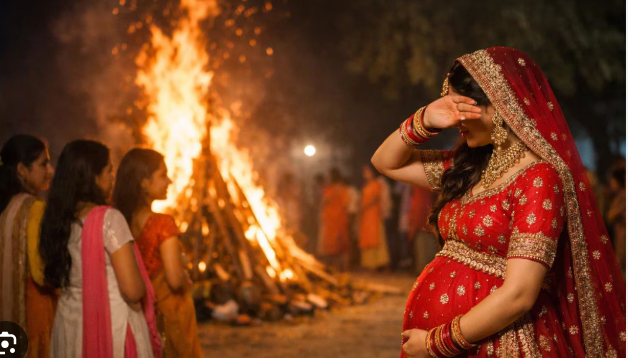
3. Pregnant Women
Pregnant women are advised to avoid standing near the fire.
The Garuda Purana discusses how strong energies and extreme heat can affect subtle pranic flow. Pregnancy is considered a spiritually delicate phase.
A verse reflecting the sanctity of protection says:
माता भूमिः पुत्रोऽहं पृथिव्याः
"The Earth is the mother, and we are her children."
Just as Earth protects life, society protects motherhood during sacred rituals.
4. Parents with Only One Child
It is believed that those who have a single child should not light the Holika fire.
The reasoning lies in symbolic protection. The ritual fire represents destruction of ego and negativity. Those with only one lineage continuation are advised to avoid invoking destructive symbolism.
This belief is rooted more in emotional safeguarding than fear.
5. People Who Have Recently Built a New House
Those who have recently constructed a new home are traditionally advised not to witness Holika Dahan.
Griha Pravesh or House Entry occurs with auspicious intentions throughout Navratri.
The fire ceremony signifies purification of negative experiences from one's past. For new homes it is important to seek a source of positive energy in a manner reflecting the reverse of what has been done throughout the ceremony.
Holika Dahan 2026 is about placing faith before fear, finding balance, and honoring sacred energies. Protecting each person's individual harmony and understanding the true meaning behind these ceremonies is how we will demonstrate Dharma, permit the purification of negative energy by the sacred fire, and retain a peaceful existence on this planet.

Comments