Why Hindus Remove Footwear Before Entering Temples: The Hidden Spiritual Science

Is Removing Footwear Before Temple Entry Only a Tradition? Here’s the Deep Spiritual Truth.
Hindu temples serve as more than just places of worship, as they have long been seen as sources of powerful energy created by the presence of divine beings, and through experiencing this energy, they create a level of harmony, connection and peace with the energetic life force we call "God". The act of removing shoes before entering a temple is one practice that takes place in nearly all Hindu temples. Even though millions of people do this daily, very few people understand the deeper, spiritual significance of this particular action - its foundation is built on many things, i.e., humility; purity; energy; discipline, etc. The importance and meaning of this ceremony can be traced back thousands of years and continues to be applicable today.

Temples Are Considered Divine Energy Centers
According to Hindu tradition, temples are thought to be powerful sources of spiritual energy. This belief stems from the fact that the majority of ancient temples are designed according to Vastu Shastra and Agama Shastra principles in order to produce and sustain positive, divine vibrations. Within a temple, the temple's sanctum (or garbhagriha) is the most spiritually uplifting area of the temple and can therefore provide direct access to God through devotion and meditation.
The shoes we wear have been exposed to dust, dirt, and many other pollutants located along the road and at public facilities. By bringing them into a temple (a place of worship) this could be viewed as disrespectful to the sanctity of the temple and its overall purity; therefore, when we take off our footwear before entering the temple, it is an act of cleanliness and purity and thus maintaining the purity of a temple and its spiritual atmosphere.
This belief is beautifully reflected in Hindu scriptures:
“शौचं बाह्याभ्यन्तरं शुद्धिः”
Purity should exist both externally and internally.
The quote says that being truly spiritual starts with being clean in body, mind, and surrounding environment; therefore, at sanatangyan, this concept of cleanliness is not just a ritual but also an awareness of the deeper meaning of why one should do so.

Why Footwear Is Always Placed to the Side
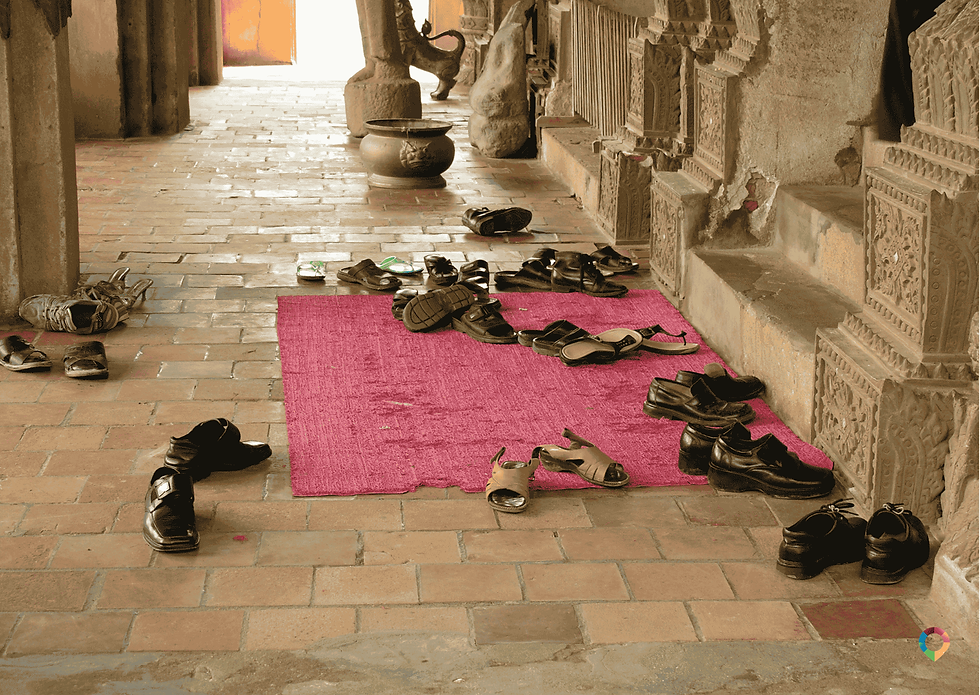
Footwear removal is only one component of this larger Hindu temple tradition; there is also an additional tradition of placing your shoes neatly off to the side rather than in the middle or blocking the entrance of the temple.
Respect for the Divine Path
The entrance of a temple is considered to represent the holy path to God. By placing shoes in the way of this path (blocking it), people show disrespect to both the deity and the other worshippers.
When shoes are left off at the entrance of a temple, it provides cleanliness, order, and a pathway for everyone to walk directly into the temple without any barriers (especially shoes or other forms of footwear). It demonstrates an awareness of others and a consideration for everyone involved while worshipping.
Symbolic Surrender of Ego
In the spiritual sense or understanding, footwear represents the worldly life (attachments, pride, distractions); therefore, by removing one’s shoes before entering the temple or the presence of God, one has symbolically left behind his/her ego and worldly concerns.
This connects beautifully with the Bhagavad Gita verse:
“निर्मानमोहा जितसंगदोषा” — Bhagavad Gita 15.5
Those free from pride, attachment, and illusion move closer to the Divine.
Based on the knowledge passed on through sanatangyan, anything that is done with awareness and devotion can be viewed as a spiritual act. Consequently, something very small - such as taking off your shoes - can become a very large spiritual act.

Spiritual Belief About Energy and Vibrations
People who visit hindu temples for blessings are said to absorb this divine energy from God using prayer, chanting, and their bare feet, or their foot touching the temple floor, to connect their physical body to this divine energy;
According to traditional belief:
Bare feet increase grounding with spiritual energy.
Temple floors absorb and radiate positive vibrations.
Shoes act as barriers that block this energetic connection.
As a result, many devotees experience a sense of peace and calm when they leave a temple after having been there barefoot.
“ईश्वरः सर्वभूतानां हृद्देशेऽर्जुन तिष्ठति” — Bhagavad Gita 18.61
The Divine resides within the heart of every being.
The temple environment is designed to awaken this inner spiritual connection.

Practical Reasons Behind the Tradition
Along with spiritual meaning, the practice also has practical benefits.
Keeping footwear outside:
Maintains temple cleanliness
Prevents dust and mud from entering
Reduces crowding at entrances
Avoids accidents or tripping hazards
Creates a more peaceful environment
Traditionally combining the spiritual and practical aspects of life through ancient cultures have created a lasting significance for today's world.
The tradition of taking off shoes before entering a temple in the Hindu religion isn't just a ceremonial act; it inspires the beliefs of purity, humility, discipline, and reverence for the divine energy which IS the temple. Shoes are reminders of how to remove your ego and worldly concerns so you can approach the god you seek. As Sanatangyan explains, those who participate in religious traditions - no matter how big or small, and understand those traditions with consciousness and devotion will discover profound truths about spirituality.

Comments