Why Can't I Control My Mind? I Tried Everything—Yet I Still Failed!

Updated: Jul 1
It's easier said than done: Control My Mind. Despite trying numerous attempts, why can't you honestly succeed? Many have succeeded in the past, so can you, but not in an incorrect manner. Let's learn what you did wrong. This solution 100% works, thanks to the authority of Guru, Saadhu, and Shashtra!

You tried everything! You gave up bad habits. You avoided distractions. You resisted cravings and made promises to yourself. At times, you even followed your new routine with full determination for 10, 15, or even 21 days.
Then suddenly, something happens.
You slip once. Then twice.
Before you know it, you're back to the same old habits you were trying so hard to leave behind. If this sounds familiar, you're not alone. But why does this happen? Why is it so difficult to control the mind?
Is the mind really that powerful?
And if controlling the mind is nearly impossible, then why should we even bother trying?
On the other hand, if it is possible, how is it that great sages, saints, yogis, and spiritually advanced people seem to have mastered it so effortlessly? Why do they make it look like a walk in the park while most of us struggle every single day?
The answer may not be what you think.
In fact, the biggest reason people fail to control their minds is that they do not fully understand what the mind is, how it works, and what it is actually designed to do. Before we learn how to control the mind, we must first understand why it refuses to obey us in the first place.
Can't Control the Mind? Culprit isn't You—It's the Senses
Most people try to control the mind directly. They try to stop overthinking. They try to stop cravings. They try to stop anger, distractions, and bad habits.
But there is a problem.
The mind is not the starting point. The mind is a junction—a meeting point where all sensory inputs arrive.
Think of it this way. Imagine a tank overflowing with water. Instead of turning off the incoming taps, you keep trying to remove the excess water from the tank. Does that make sense?
Of course not.
As long as water keeps pouring in, the tank will continue to overflow. The same thing happens with the mind. The mind receives a constant stream of inputs from the five senses—what you see, hear, smell, taste, and touch. In Vedic literature, these are called Jñānendriyas (ज्ञानेंद्रियां), the instruments through which we gather knowledge.
But today, most people do not use their senses merely for knowledge. They use them for constant stimulation. Unlimited scrolling. Endless videos. Constant notifications. Tempting food. Entertainment on demand.

The senses are never allowed to rest. And because the senses are constantly active, the mind never gets a chance to become peaceful.
But there is an even deeper problem. The issue is not the senses themselves. The issue is attachment or aversion. Think about what happens when you sleep. Sounds may be present. Smells may be present. People may even be talking nearby. Yet none of it disturbs you because you are not interested in those inputs.
The senses may receive information, but your attention is not attached to it. The same principle applies when you are awake. The moment you become interested in a sensory object, attraction or aversion begins.
You like it, you dislike it. You want more of it, you want to avoid it. These reactions create impressions in the mind, known as saṁskāras. Over time, these impressions accumulate and become powerful mental tendencies.
So the real problem is not that the senses are receiving information. The real problem is that we become attached to what our senses receive. Every attachment strengthens an impression. Every impression strengthens the mind's demands. And every demand makes self-control more difficult.
Now consider this question.
Which monkey is easier to control—a normal monkey or an intoxicated monkey? Most people would agree that an intoxicated monkey is far more difficult to manage. Yet many of us spend hours every day feeding our senses with unlimited stimulation and then wonder why the mind refuses to cooperate.

Without regulation, the senses keep creating impressions. Those impressions keep strengthening desires. And those desires keep strengthening the mind. In other words, we are unknowingly making the mind more powerful every single day. And then we wonder why controlling it feels impossible.
So before asking how to control the mind, you must ask a more important question:
Are you regulating the inputs that are strengthening the mind?
Controlling the Mind: The Forgotten Power of Saying No!
The human system is designed with a natural hierarchy. The higher should guide the lower.
The wiser should guide the impulsive. The protector should never become the servant of the one it is supposed to protect.
Yet that is exactly what happens in most people's lives.

In the Bhagavad Gita, Lord Krishna explains that the senses are powerful, but the mind is higher than the senses. Higher than the mind is the intelligence (buddhi), and higher still is the self.
In theory, this means the intelligence should be able to guide and control the mind. But does that happen in real life?
Not always.
Imagine entering a noisy classroom full of students. You ask them to be quiet. Nobody listens. A few seconds later, the headmaster enters the room. Suddenly, there is complete silence.
What changed?

The students recognized a higher authority. The same principle applies within us. The mind knows when the intelligence is strong. When intelligence speaks with conviction, the mind listens. But when intelligence becomes weak, compromised, or addicted to pleasure, the entire system becomes corrupted.
The rakshak becomes the bhakshak. The protector becomes the oppressor. The master became the servant.
Consider a chain smoker. He reaches into his pocket, looking for a cigarette. Nothing is there. He checks again. Then his bag. Then every place where he might have hidden a pack.
What is happening?
The mind is demanding a cigarette. But notice something important. The mind cannot walk to the shop by itself. It needs help. It turns to the intelligence.
"Where can I get a cigarette?"
And the intelligence replies: "Go to the shop around the corner." At that moment, intelligence is no longer leading. It is serving. It has accepted the false belief that smoking will bring happiness, and therefore, it works for the mind rather than governing it.

The same thing happens with every habit and every addiction.
The mind wants. The intelligence justifies. The mind demands. The intelligence provides excuses. The mind craves. The intelligence creates a plan to satisfy the craving. And then we wonder why the mind feels impossible to control.
The problem is not that the mind is too powerful.
The problem is that the intelligence has surrendered its authority. So what is the first step toward regaining control? A simple two-letter word.
NO
Every time you say "No" to an unhealthy impulse, you strengthen your intelligence. Every time you refuse a craving, you remind the mind that it is not in charge. Every time you choose long-term benefit over short-term pleasure, the proper hierarchy is restored.
Many people think discipline is a restriction.

In reality, discipline is freedom. The person who cannot say "No" is controlled by circumstances. The person who can say "No" controls his own life.
This is why Krishna advises Arjuna that the restless mind can be controlled through practice and detachment. Not through wishful thinking. Not through motivation alone.
But through repeated effort and the willingness to say "No" when necessary.
In fact, we see proof of this all around us.
Control My Mind: Proof "NO" Always Works!
Consider a chain smoker who has been smoking for twenty or thirty years.
One day, the doctor looks him in the eye and says: "One more cigarette and you could die."
Something remarkable often happens. The same person who could not control his craving yesterday suddenly stops smoking. Not gradually. Not after months of struggle. Sometimes immediately.
What changed?
Did the craving disappear? Not necessarily. Did the cigarette become less addictive overnight?

Of course not.
What changed was authority!
Until that moment, the intelligence had been serving the mind. It had accepted the idea that smoking was pleasurable and harmless enough to continue. But the moment survival became more important than pleasure, the intelligence took back control.
It said: "If I continue this habit, I may die."
And suddenly the mind was forced to listen. This proves an important point. The mind is not always the strongest force within us. When the intelligence becomes sufficiently convinced, it can overpower even years of conditioning.
Consider another example.
A person suffering from jaundice often finds sweet things bitter. Even sugarcane juice may taste unpleasant.
Yet doctors still recommend it. Initially, the patient may dislike the taste. The mind resists.
But after repeatedly following the treatment and seeing improvement, something changes.
The intelligence observes the results.
"This is helping me."

Gradually, the resistance decreases. The patient continues. And eventually, as health returns, the natural sweetness becomes apparent again.
In both examples, the principle is the same.
The mind follows what appears pleasurable in the moment. The intelligence sees the larger picture.
When intelligence is weak, pleasure wins. When intelligence is strong, wisdom wins.
This is precisely why the Bhagavad Gita verses (2.62 - 2.63) repeatedly emphasize guarding the intelligence.
A person repeatedly contemplating sense objects develops attachment. (ध्यायतो विषयान्पुंसः सङ्गस्तेषूपजायते). Attachment develops into desire. Desire clouds judgment. And once judgment is clouded, intelligence loses its power to guide (स्मृतिभ्रंशाद्बुद्धिनाशो बुद्धिनाशात्प्रणश्यति).
The problem begins long before the action. It begins with what we repeatedly allow our minds to dwell upon. If you constantly feed desires, the intelligence becomes covered.
If you strengthen intelligence through reflection, discipline, and higher understanding, the mind gradually returns to its proper place.

The goal is not to destroy the mind. The goal is to restore the intelligence to its rightful position as the guide. However, this raises an important question. If we keep saying "No" to pleasure, won't life become dry and joyless?
Is there a way to experience a higher happiness without becoming dependent on the senses? That is the question we must answer next.
Controlling the Mind is well and good, but what about my Pleasures?
The strongest resistance we face when trying to control the mind is this: "If I give up my pleasures, how will I live?"
And honestly, that is a valid question. Many people think self-control means becoming a monk overnight. They imagine a life without enjoyment, without excitement, and without happiness.
But that is not what the Vedic scriptures teach.
The soul is described as Sat-Chit-Ananda.
Sat — eternal by nature.
Chit — full of awareness and knowledge.
Ananda — naturally seeking happiness and pleasure.
Wanting happiness is not a defect. It is part of your nature. Just as water naturally flows downward and fire naturally gives heat and light, the soul naturally seeks happiness.
The real question is not whether you should seek pleasure.
The real question is: What kind of pleasure are you seeking?
The Bhagavad Gita explains that not all pleasures are equal. Broadly speaking, pleasures can be influenced by the three modes of nature: ignorance (tamas), passion (rajas), and goodness (sattva).
Not all pleasures demand the same price. The price from lowest to highest is too steep; it comes at the cost of your existence, either your awareness, your immortality (consciousness or soul), or both of them simultaneously. We will understand this in a bit.
Let's begin with the lowest type.
Tamasic Pleasure: Pleasure That Costs You Your Future
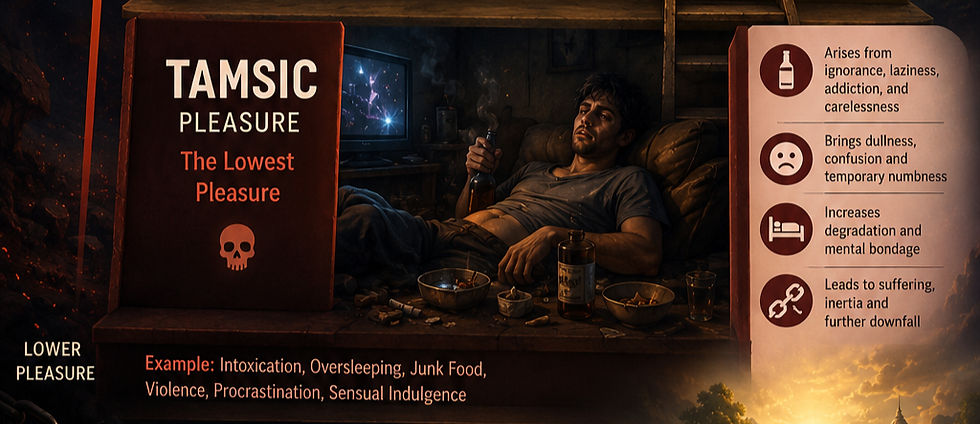
Tamasic pleasure is pleasure born from ignorance. It promises relief, excitement, or escape in the present moment while hiding the consequences that will come later. Its greatest attraction is that it requires little effort and gives immediate gratification. It is bitter in the beginning, and grants a horrible experience at the end.
Consider alcohol.
A person drinks because he wants relief from stress, anxiety, loneliness, or problems. For a short while, the mind feels lighter. Thoughts become slower. Worries appear to disappear. But have the problems actually gone away?
No!
The person has simply become less aware of them. This is the nature of tamasic pleasure.
It does not solve problems. It temporarily covers them. The next day, the problems return.
Often with a hangover. Then the person seeks a stronger dosage. And gradually, the habit begins to control the person rather than the person controlling the habit.
Tamasic pleasure works by reducing awareness
It pulls a person away from purpose, responsibility, and higher understanding. The same principle can be seen in excessive sleeping, intoxication, escapism, and any activity that encourages forgetfulness rather than awareness. This is why tamasic pleasure directly opposes the Chit aspect of our nature—the desire for awareness and knowledge.
And it often opposes the Sat aspect as well, because habits born in ignorance frequently damage health, shorten life, and weaken the body. In other words, tamasic pleasure asks you to sacrifice your future for a momentary experience.
Take the example of pleasure derived solely from the tongue,i.e., meat eating. A few moments of taste may seem insignificant. Yet according to the law of karma, every action creates a reaction. In this case, the karma created is "Māṁsa".
The Sanskrit expression "Māṁsa" is sometimes explained as: "Mām saḥ khāditi" — "Today I eat him; tomorrow he may eat me." The idea is simple. When we inflict suffering upon another living being for our own enjoyment, we create karmic obligations that must eventually return to us.

From a Vedic perspective, the soul is immortal. Its true destination is to rise above repeated birth and death and return to its eternal nature. But every selfish action rooted in ignorance strengthens our bondage to the cycle of karma.
Now pause and think about that for a moment. What is the actual transaction taking place?
A few moments of pleasure on the tongue, and you give away your immortality. You get entangled in another cycle of life: birth, old age, death. and diseases.
That is why it is considered the lowest form of pleasure. The tragedy is not that it gives pleasure. The tragedy is that the price is often far greater than the reward.
Tamsic Pleasure: Enjoyment from inflicting killing/pain on others
In exchange for two minutes of pleasure, you get further entanglement in birth, death, old age, and disease, another karmic account that must eventually be settled, further delaying your journey toward freedom from material existence.
There is a main reason tamasic pleasure is considered dangerous in the Vedic understanding. It often asks us to exchange something infinitely valuable for something temporary.
When viewed from this perspective, tamasic pleasure appears far less attractive. For a few minutes of sensory enjoyment, we may be trading something far more valuable—our progress toward liberation and immortality.
That is why the scriptures repeatedly ask us to look beyond immediate pleasure and examine its long-term cost.
Tamsic Pleasure asks you to trade awareness for forgetfulness. Purpose for escape. Growth for comfort. And immortality for repeated births.
Rajasic Pleasure: Sweet in the Beginning, Bitter in the End

If tamasic pleasure is pleasure born from ignorance, then rajasic pleasure is pleasure born from passion. This is the pleasure most people chase every day.
The Bhagavad Gita explains that when the senses come into contact with their objects, a pleasurable sensation arises. The eyes enjoy beautiful sights. The ears enjoy pleasant sounds. The tongue enjoys delicious food. The skin enjoys pleasurable touch. The sensation feels good.
And because it feels good, we assume it must be happiness.
But is it?
Consider any sensory pleasure. A delicious meal. Sexual pleasure. Money. Recognition. Luxury. Power. Fame.
The anticipation is often greater than the experience itself. The mind keeps saying: "Once I get this, I will finally be satisfied."
Then the pleasure arrives.
For a brief moment, there is excitement. Then the excitement fades. And the mind starts searching for the next object. This is the cycle of rajasic pleasure. It promises satisfaction but rarely delivers lasting fulfillment.
Take the example of sexual pleasure.
The mind spends days, weeks, or even months imagining the experience. The anticipation builds. The desire grows stronger. The mind becomes convinced that happiness lies on the other side of gratification. Then the moment arrives.
For a few seconds, it seems there is intense pleasure. The tension disappears. The mind becomes temporarily quiet. But how long does that state last?
A moment, then it feels slipping away.
Soon, the mind begins seeking stimulation again. The cycle repeats. The problem is not pleasure itself. The problem is dependence. When happiness becomes dependent upon external objects, the mind becomes their servant.
The more we seek happiness outside ourselves, the more self-power we give away.
This is why rajasic pleasure is described as sweet in the beginning but bitter in the end.
It excites us at first. But attachment, anxiety, competition, frustration, jealousy, heartbreak, and disappointment often follow. Rajsic pleasure/Mode of passion is sense gratification. Hyperexcitation or ultra-titillation of senses.
The by-product of Rajsic pleasure is greed; it is never fulfilled, it wants more in the very next second. It's impossible to sustain as it doesn't exist in the first place. Just an illusion that everlasting pleasure is there in the material world.
Rajsic Pleasure: A Betrayal of disguising titillation/excitation as pleasure
Look around.
How many conflicts begin because of uncontrolled passion? How many broken relationships? How many betrayals? How many crimes are committed for money, power, status, or desire?
Passion creates movement. But when left unchecked, it leads to sense gratification, which creates suffering. Human life was not designed merely for sense gratification. There is another way to use this same energy.
Getting the same pleasure through engagement. Let's move to the last type of pleasure that is meant to be enjoyed by humans.
Sattvic Pleasure: Bitter in the Beginning, Nectar in the End

Till now, we have seen two kinds of pleasure. Tamasic pleasure sacrifices the future for the present, trades your immortality for a few moments of pleasure. Rajasic pleasure creates excitement but often leaves behind attachment and dissatisfaction. A trade of your intelligence and peace for a few moments of pleasure
You seek eternity. You seek knowledge. And you seek pleasure.
Is there a pleasure that does not steal our future? A pleasure that does not leave misery in its wake?
Yes!
There is indeed. Sattvic pleasure: The Mode of Goodness amongst all three pleasures! You cannot live without pleasure. Why?
Ānandamayo'bhyāsāt” (आनन्दमयोऽभ्यासात्), a famous Vedānta Sūtra (1.1.12)
Because your very nature is Sat-Chit-Ananda, notice the order. Not Ananda, Chit, Sat. Not pleasure first.
It is Sat-Chit-Ananda. First comes existence. Then comes awareness. Then comes pleasure.
The problem with most people is that they reverse the sequence. They put pleasure first.
And when pleasure becomes the center of life, awareness begins to decline, and eventually life itself deteriorates.
A man without purpose will easily fall to pleasure.
Now, let's understand Sattva Guna. Sattva Guna is the mode of awareness, learning, and understanding things as they are. But how does one become knowledgeable? Not by claiming, "I know everything."
A real seeker knows what he does not know
There are four stages. First comes the Mudha/fallen state. Then comes the fool. After that comes the Agyani. Finally comes the Gyani.
The Mūḍha (मूढ) individual is so ignorant that instead of questioning that he doesn't know, he wants the world to revolve around him. He says that the floor is tilted instead of saying he doesn't know how to dance.
The next type is (मूर्ख)fool. He does not know that; he knows nothing. That is the dangerous part.

As the saying goes: "Murkho ke sar par seeng nahi hote." Fools don't have horns on their heads. The fool does not know he is a fool. Therefore, he never questions himself.
After that comes the Agyani (ignorant). The Agyani knows: "I don't know."
And that is where the journey begins. Questions arise. Curiosity arises. The search for truth begins.
Finally comes the Gyani. The person who has learned, questioned, experienced, and understood. But see carefully. The key stage is not Gyani. The key stage is Agyani. The moment you realize you do not know, growth begins. That is why learning itself is a Sattvic pleasure.
Every day you learn something new, your awareness expands. Every day you challenge your assumptions, your consciousness expands. Every day, you clean the dust accumulated on the mirror of the mind.
Once you learn how to ride a bicycle, you never have to relearn riding. But you can always become a better rider. Similarly, life is not about perfection. Pursue excellence, not perfection.
Perfection is one of the greatest myths of the mind. Growth is real. Learning is real. Improvement is real.
That is Sattva Guna. And yes, Sattva Guna feels bitter in the beginning. Like poison.
Learn a new language. Learn a new software. Learn a new skill. Start exercising. Start meditating. Initially, it hurts. You fail. You struggle. You fall, just like a child learning to ride a bicycle.
But what happens later?
Confidence. Clarity. Knowledge. Strength. Freedom.
That is why Krishna says that Sattvic happiness appears like poison in the beginning but nectar in the end.
The beautiful thing about Sattvic pleasure is that it does not take away your awareness.
It increases it. It does not weaken your intelligence. It strengthens it. It does not take away your future. It improves it. And then comes an even higher stage.
Vishuddha Sattva; Pure goodness!
At this stage, your existence itself becomes pleasurable.
You do not need constant stimulation. You do not need constant entertainment. You do not need constant validation. Simply being alive becomes pleasurable. Your very existence becomes a source of happiness. This is called Divya Sukha.Pleasure beyond the senses.
The Bhagavad Gita explains that even a fragment of this higher happiness makes ordinary pleasures seem insignificant.
यं लब्ध्वा चापरं लाभं मन्यते नाधिकं ततः। यस्मिन्स्थितो न दुःखेन गुरुणापि विचाल्यते॥ ६.२२॥
Having attained this inner happiness, one considers no other gain greater. Situated in this consciousness, one is not shaken even by the greatest distress.
Why? Because it is not cheap titillation. It is deep satisfaction. There is a difference between quantity and quality.
A swamp (sensual pleasure) may contain more water than a drop from the ocean (soul pleasure). But that drop still contains the nature of the ocean. Similarly, even a small glimpse of higher happiness is more valuable than an ocean of lower pleasures.
And the best part? You do not have to wait until the end of the journey. The moment you begin moving from Tamas to Rajas, from Rajas to Sattva, and from Sattva to Vishuddha Sattva, the process begins.
The reward begins. The satisfaction begins. So yes, pursue pleasure. Without pleasure, you cannot survive. But pursue Sattvic pleasure.
Seek pleasure that does not cost you your immortality. Seek pleasure that does not cost you your awareness. Seek pleasure that makes you more conscious, more alive, more free.
That is the pleasure worth pursuing.
Control My Mind: How Do I Actually Move Higher?

Moving from lower pleasures to higher pleasures sounds beautiful. It sounds spiritual. It sounds inspiring. But let's be honest. For most people, it sounds like a utopia. It sounds completely disconnected from reality.
You are here, stuck in habits, addictions, distractions, impulses, and somebody tells you to simply move to higher pleasures.
How?
That is precisely why Patanjali gave practical systems of Yoga. Yoga means linking yourself to something higher.
Bhoga means remaining linked to pleasure. Right now, most people are linked to Bhoga. That is why they keep listening to their pleasures and not their intelligence. That is why they know what is right and still end up doing what is wrong.
Now, suppose tomorrow morning you suddenly decide: "From today, I will only listen to my intelligence."
Will it work? No!
Why?
Because your intelligence is not yet that powerful.
As we saw earlier, your intelligence has been serving your senses for years. The protector has become the servant. The intelligence sees pleasure as everything. It sees Rajasic pleasure as happiness. It sees Tamasic pleasure as happiness. And therefore, it keeps helping the mind obtain them.
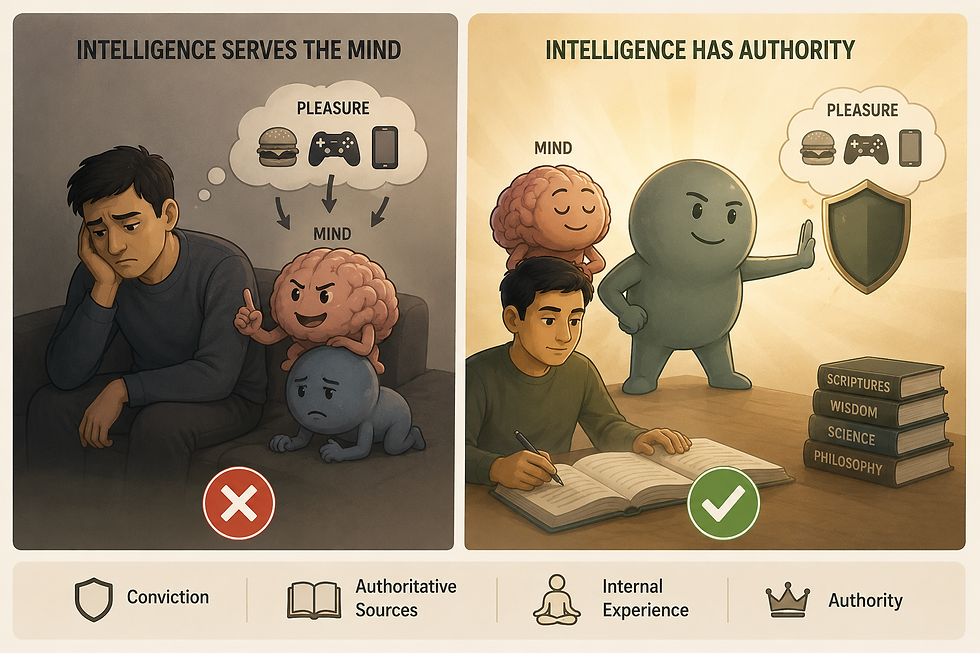
This is why Krishna explains in the Bhagavad Gita that mere repression does not work.
सदृशं चेष्टते स्वस्याः प्रकृतेर्ज्ञानवानपि । प्रकृतिं यान्ति भूतानि निग्रहः किं करिष्यति॥ ३.३३ ॥
Even a man of knowledge acts according to his own nature, for everyone follows the nature he has acquired from the three modes. What can repression accomplish?
You cannot simply suppress your nature. Everyone acts according to their conditioning. Everyone acts according to the modes of nature they have associated with. Your current habits did not appear overnight. You created it slowly. One day at a time. One habit at a time. One indulgence at a time.
So how do you change it? The same way you created it.
Slowly. One step at a time. The first principle is regulation. Not suppression.
Regulation (नियमन)!
रागद्वेषवियुक्तैस्तु विषयानिन्द्रियैश्चरन् । आत्मवश्यैर्विधेयात्मा प्रसादमधिगच्छति ॥ २.६४ ॥
A person free from attachment and aversion and able to control his senses through regulative principles attains the mercy of the Lord
Suppose you spend four hours scrolling on your smartphone. Do not aim for zero tomorrow. Start with regulation. Set a timer every fifteen or twenty minutes. If out of ten attempts you successfully stop yourself three times, that is progress.
Why?

Because for those three moments, your intelligence won. For those three moments, you exercised your decision-making ability. For those three moments, you strengthened the very faculty that is supposed to control the mind.
Or suppose you overeat. Do not suddenly begin starving yourself. Simply eat one chapati less. Then another. Then another. You progress gradually.
People often say, "Do something for 21 days." OR "Do something for 66 days."
There is truth in that.
But the real secret is not repeating the same effort for 66 days. The real secret is gradually increasing regulation. The above BG verse 2.64 explicitly contains:
ātma-vaśyaiḥ (controlled senses) and vidheyātmā (regulated self-discipline)
Give up bad habits in repeated sets. That is for a 21-day stay away from the selected habit. Then live normally for 1 week or fortnight, then for the next 66 days straight, stay away from the same habit.
Don't try to quit a bad habit all at once. Reduce it gradually— from 100 to 90 days, then from 90 to 80 days, then from 80 to 70 days, and so on—until you can stay free from it for 365 days, or an entire year!
Slowly. Steadily. Consistently.
That is the first step. The first step in saying NO. The way to practice regulation.
However, regulation is not the final step.
Regulation alone is not enough
This is where most people fail. Most of us only reach here. They don't know that to rise above base desires, you need to understand more about desires and how they exist.
You see, most of us keep removing lower pleasures but never replace them with higher pleasures. And therefore, the mind keeps pulling us back. Krishna explains this beautifully.
विषया विनिवर्तन्ते निराहारस्य देहिनः। रसवर्जं रसोऽप्यस्य परं दृष्ट्वा निवर्तते॥ २.५९ ॥
Though the embodied soul may be restricted from sense enjoyment, the taste for sense objects remains. But, ceasing such engagements by experiencing a higher taste, he is fixed in consciousness.
A person may give up sensual pleasures, but the taste for them remains. The memory remains. The attraction remains. But when a person experiences a higher pleasure, the lower pleasure naturally loses its grip.
Think about your childhood.
You used to play with toys all day. Today, you don't. Did you suppress the desire?
No.
You found better toys. Life itself provided higher engagements. The lower attraction faded automatically. The same principle applies here!
.

If someone is dependent on alcohol, the goal is not merely to remove alcohol. The goal is to find something that provides the same relief, the same lightness, the same satisfaction in a healthier and higher way.
Then, side by side, two things happen. The lower pleasure is gradually reduced. The higher pleasure is gradually increased.
Day after day. Week after week. Month after month. One decreases. The other increases. And eventually the balance shifts. This is how real transformation happens.
Not overnight. Not through force. But through intelligent replacement.
In fact, this principle is found everywhere. A seed does not become a tree overnight. It grows slowly. Silently. Consistently.
Similarly, your current condition was not created overnight. You became what you are through thousands of repeated actions. If repeated actions can make a person miserable, repeated actions can also make a person free.
You have already mastered one thing. You have mastered your current habits. Now the same process must be used consciously. The same consistency. The same repetition. The same commitment. But directed upward.
However, there is still one final challenge.
Even higher pleasures of the body and mind are still not the highest pleasure. The highest pleasure is YOU YOURSELF!
Remember, you are made up of sat-chit-anand. Even if one is absent in your being, you can't exist in your natural state.
However, your current state is as described below:
ईश्वरः सर्वभूतानां हृद्देशेऽर्जुन तिष्ठति ।भ्रामयन्सर्वभूतानि यन्त्रारूढानि मायया॥
The Supreme Lord is situated in the hearts of all beings, O Arjuna, and causes them to wander according to their karma while they are seated on a machine made of material energy.
You are sitting in a material machine, living in the world through material machine senses. A temporary unnatural existence, and you think, " Why aren't you happy?

You are not merely a body. You are not merely a mind. You are originally a spirit soul. Then what is your natural state?
It is beautifully described here:
ब्रह्मभूतः प्रसन्नात्मा न शोचति न काङ्क्षति । समः सर्वेषु भूतेषु मद्भक्तिं लभते पराम् ॥ १८.५४ ॥
One who is thus transcendentally situated at once realizes the Supreme Brahman and becomes fully joyful. He never laments nor desires to have anything; he is equally disposed toward every living entity. In that state, he attains pure devotional service unto Me.
You are not naturally situated currently. Your current existence or situation is material, not spiritual. You might succeed in controlling your mind for hours, days, or months, but you will again fall to the material senses' pleasure level of consciousness.
Until you experience the pleasure of your real nature, there will always remain the possibility of falling back.
However, if you still keep giving in to sensory pleasures, you will be a slave to your senses. As discussed above, the nature of sensory pleasures is agitation or inner disturbance; it increases greed and dissatisfaction in an individual.
Furthermore, if you forcefully enjoy in this life through senses, then you will never attain inner peace and freedom from this material existence, or in your case, the mind.
Difficult to believe? The Bhagavad Gītā verse 5.25 proves it:
लभन्ते ब्रह्मनिर्वाणमृषयः क्षीणकल्मषाः । छिन्नद्वैधा यतात्मानः सर्वभूतहिते रताः ॥ ५.२५ ॥
Those whose sins are destroyed, whose doubts are cut off, whose minds are controlled, and who work for the welfare of all beings attain spiritual peace and liberation.
There is no other option other than replacing the sensory pleasures with a higher pleasure. Which raises the final question: How do we reach the highest pleasure?
That is what we will discuss next.
HIGHEST PLEASURE: YOGA or Linking with SUPREME
The pleasure of Vishuddha Sattva. The pleasure beyond the senses. The pleasure of simply being. The pleasure of a relationship with the Supreme. This is the pleasure you should seek if you want to control the mind.
It is bitter in the beginning but sweet at the end. It requires sense engagement, not sense gratification. Remember, as discussed till now, controlling the mind is the result of regulating the senses, and seeking higher pleasure, and there is no higher pleasure than this, but it is bitter in the beginning, and sweet, ambrosia at the end.
There are three ways or Yogas to link with the supreme.
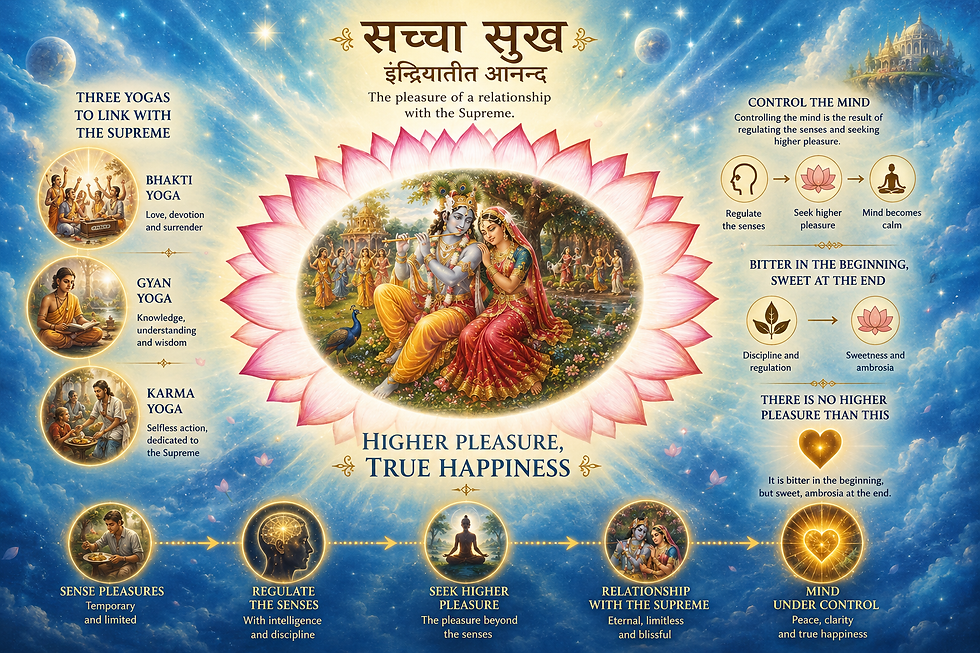
Bhakti Yoga, Gyan Yoga, and Karma Yoga. We will start with the most practical, easy, blissful, and pleasing to the senses Yoga.
Bhakti Yoga: The Simplest Way to Control the Mind
Bhakti Yoga, as the name suggests, is about loving the Supreme. When we say "love" in this world, most of the time it is mixed with personal desires, expectations, and attachments. But when that same love is directed toward the Supreme Creator, it becomes bhakti.
Originally, according to the Vedic scriptures, the Supreme is Krishna, the Supreme Personality of Godhead. But even if your understanding has not yet reached that stage, you can begin by developing love for the Creator, the source of everything. That loving connection with the Supreme is called Bhakti Yoga.
Bhakti means linking with the Supreme through your heart, through your feelings, through your relationship.
Now, we are living in Kali Yuga—the age of quarrel, confusion, distraction, machines, notifications, and endless stimulation. The Vedic scriptures repeatedly emphasize that the recommended process for spiritual advancement in this age is very simple:
हरेर्नाम हरेर्नाम हरेर्नामैव केवलम् । कलौ नास्त्येव नास्त्येव नास्त्येव गतिरन्यथा ॥
In this Age of Kali, the holy name of Hari, the holy name of Hari, the holy name of Hari alone is everything. There is no other way, no other way, no other way for spiritual advancement
So how do we actually practice bhakti? The answer is given in a famous definition of devotion:
सर्वोपाधि-विनिर्मुक्तं तत्परत्वेन निर्मलम् । हृषीकेण हृषीकेश-सेवनं भक्तिरुच्यते ॥
When one is freed from all material designations, and the senses are purified, engaging those senses in the service of Hṛṣīkeśa (the Lord, the master of the senses) is called bhakti.
The senses cannot remain inactive; when the senses (hṛṣīka) are engaged in serving the Master of the senses (Hṛṣīkeśa), that purified engagement is called bhakti. Bhakti means using the senses in the service of the Master of the senses. And if you think about it, that is exactly what this entire article has been trying to teach.
You do not fight the mind directly. You regulate the senses, and the mind follows.
The senses are constantly looking for engagement. The eyes want to see. The ears want to hear. The tongue wants to taste. The skin wants to touch. The nose wants to smell.
Bhakti Yoga does not ask you to destroy the senses. It asks you to engage them properly.
See Krishna in deity form. Hear about Krishna. Chant Krishna's names. Offer food to Krishna. Use your abilities in Krishna's service.
Krishna Himself explains this principle in the Bhagavad Gita:
यत्करोषि यदश्नासि यज्जुहोषि ददासि यत् । यत्तपस्यसि कौन्तेय तत्कुरुष्व मदर्पणम् ॥ ९.२७ ॥
"Whatever you do, whatever you eat, whatever you offer or give away, and whatever austerities you perform—do that as an offering unto Me."
This is Bhakti Yoga.
Whatever you do, do it through Krishna. Whatever you consume, offer it first to Krishna.
Whatever talent you have, use it in Krishna's service. Whatever success comes, offer it to Krishna.
It may sound difficult at first because many of us feel, "I don't have that much devotion. I don't have that much feeling." But the beauty of Kali Yuga is that the easiest doorway into bhakti is Sankirtan.
Sankirtan means chanting the names of God together. Singing the names of God. Glorifying the Lord through kirtan. And almost everyone can do it. You can see it in ISKCON temples, villages, spiritual gatherings, and Nagar Sankirtans across India. People gather together and sing. They play mridanga, kartals, and other instruments.
They sing the compositions of great Vaishnava acharyas and saints such as Sant Tukaram, Mirabai, Haridas Thakur, Narottama Dasa Thakura, Bhaktivinoda Thakura, and many others.
And something wonderful happens. The heart begins to soften. The mind becomes lighter.
The burden of endless thinking temporarily disappears. Even a person who knows nothing about Bhakti Yoga can experience the uplifting effect of sincere kirtan.
Kirtan is like song and dance, but it has a stacking effect. The first time you do it, you feel something. The second time, you feel a little more. The tenth time, more. The hundredth time, more. This is very different from material pleasures.
Material pleasures give maximum excitement in the beginning and less satisfaction later.
Spiritual pleasure works in the opposite direction. The more consistently you practice, the more the taste increases.
Then comes japa meditation.
In ISKCON, the standard practice is chanting sixteen rounds of the Hare Krishna Mahamantra daily, as taught by His Divine Grace A. C. Bhaktivedanta Swami Prabhupada.
But don't get intimidated by that number.
Start with one round. If one round feels easy, do two. One round hardly takes a few minutes.
The important thing is consistency. Once the taste develops, increasing becomes natural.
You will not have to force yourself.
Then, gradually, another beautiful transformation begins. You stop seeing food merely as food. You begin offering it to Krishna and honoring it as prasadam. You stop seeing your work merely as work. You begin offering it to Krishna. You stop seeing your life as a collection of separate activities.
Everything becomes connected to the Supreme.
And when your senses become connected to Krishna, the senses become purified. The mind becomes purified. The intelligence becomes stronger. Life becomes simpler.
Slowly and steadily, you begin to realize something profound: Human life is not meant for sense gratification. Human life is meant for sense engagement.
A materialistic person uses the senses to enjoy sense objects. A devotee uses the senses to serve Krishna. Externally, both may be eating, walking, talking, working, and living.
But internally, the consciousness is completely different.

One enjoys separately from God and accumulates karmic reactions.
The other offers everything to God and gradually becomes free from karmic bondage.
That is the difference between a bhakta and an abhakta. A spiritual person enjoys through Krishna. A materialistic person tries to enjoy independently of Krishna.
So if you want a practical method to control the mind, Bhakti Yoga is perhaps the most natural path. Offer everything to Krishna. Live through devotion. Link yourself to the Supreme.
The process is so sublime and so pleasurable that after some time, it no longer feels like discipline. It becomes your nature.
And one final secret: Always associate with like-minded devotees. This is called satsanga.
Without good association, progress becomes difficult. With good association, progress becomes natural. When you spend time with people who are sincerely practicing bhakti, you begin absorbing their habits, their values, and their enthusiasm. Without much effort, you will find yourself moving closer to the goal. You will enjoy the process. You will not feel deprived.
And gradually, without fighting the mind directly, the mind will come under control. That is the gift of Bhakti Yoga.
Jnana (ज्ञान)Yoga: The Path of Understanding and Witnessing
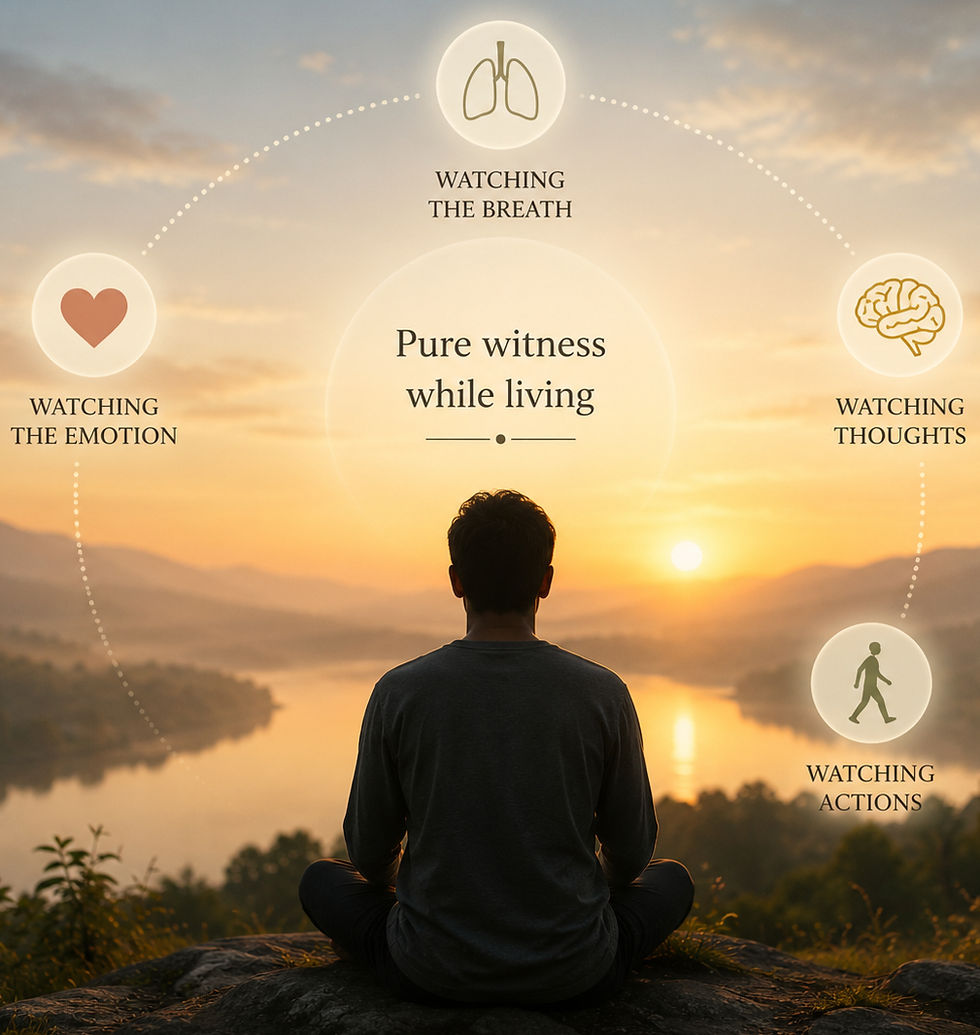
The second path is Jnana (ज्ञान)Yoga. Jnana Yoga can be divided into various streams and traditions. Some people associate it with Sankhya Yoga, some with Raja Yoga, some with Dhyana Yoga. Different teachers explain it differently. But at its core, it is the path of understanding, inquiry, awareness, and knowledge.
And to be honest, Jnana Yoga is difficult.
Very difficult.
It requires intelligence, discipline, patience, and a genuine desire to know the truth. It is not the easiest path in the present age.
But not everyone is naturally emotional.
Not everyone can immediately connect through devotion. Some people first want to understand. They want answers. They want knowledge. They want experience before faith.
Jnana (ज्ञान)Yoga is for such people.
Many masters have explained this path in different ways, but one of the simplest explanations in modern times was given by Osho Rajneesh.
Osho repeatedly emphasized a very simple practice: Witnessing
Live moment to moment. Watch yourself. Observe yourself. Become aware of what you are doing while you are doing it.
If you are walking, know that you are walking. If you are eating, know that you are eating.
If you are speaking, know that you are speaking. If anger arises, observe the anger. If desire arises, observe the desire. If fear arises, observe the fear.
Simply witness.
This principle is closely related to what the Japanese call Wu Wei—often translated as "effortless action" or "action through non-forcing." Although the term comes from Taoist philosophy rather than Japanese philosophy, the essence is similar: allowing life to flow naturally without unnecessary resistance.
Osho beautifully explained that life exists only in the present moment. One moment ends. Another moment begins. Then another. Then another.
If you can remain present from moment to moment, witnessing everything that happens within and around you, something remarkable begins to occur.
Awareness deepens. And that awareness gradually leads toward meditation. This is an important point. Meditation is not something you can force.
Nobody can "do" meditation.
Just as you cannot force sleep to happen, you cannot force meditation to happen. You simply create the right conditions. Sleep happens. Meditation happens.
Witnessing creates those conditions.
The more deeply you witness, the more naturally meditation begins to arise on its own.
Many of these witnessing techniques are discussed in the Vigyan Bhairav Tantra, where Lord Shiva explains various methods of awareness and meditation to Goddess Parvati. The text contains numerous techniques designed to bring the practitioner into direct awareness of the present moment.
If you are naturally inclined toward knowledge, observation, and self-inquiry, Jnana Yoga can be a beautiful path.
However, I would also like to share a personal observation.
After progressing in witnessing for some time, many people eventually discover that the peace they are seeking through awareness becomes even more accessible through kirtan and devotion.
This is why many seekers gradually move from Jnana Yoga toward Bhakti Yoga.
Not because Jnana Yoga is wrong. But because Bhakti often becomes easier, sweeter, and more natural. Especially in Kali Yuga.
The scriptures describe Kali Yuga as an age of short lives, constant distractions, quarrels, anxiety, confusion, and disturbance. Everywhere there is turbulence.
Adhyatmika suffering (suffering from one's own body and mind). Adhibhautika suffering (suffering caused by other living beings). Adhidaivika suffering (suffering caused by natural and cosmic forces).
Life itself has become complicated.
This is one reason why the saints repeatedly recommend Sankirtan—the congregational chanting of the holy names of God.
For most people, it is simply more practical. More accessible. And more joyful. But every individual is different.
If witnessing resonates deeply with you, continue with Jnana Yoga. Continue observing. Continue inquiring. Continue seeking.
The important thing is not the label. The important thing is that you move toward the Supreme. Whether through devotion or through knowledge, the goal remains the same.
Because ultimately, if you truly want to control the mind, you must connect yourself to something higher than the mind. You must connect with the Supreme.
Jnana Yoga attempts to reach that realization through understanding. Bhakti Yoga attempts to reach it through love.
The destination is the same. Only the journey is different.
Karma Yoga: The Most Misunderstood Path
The third path is Karma Yoga. And Karma Yoga is probably one of the most misunderstood concepts in the world. People think that whatever action they perform is Karma Yoga.
No, it is Karma, not Karma Yoga!
Whatever action you perform is simply an action—a kriya. When intention gets added to action, it becomes karma.
That distinction is very important.

Suppose a person kills another person. If he kills in self-defense to protect his own life, the law itself does not treat it the same as murder. But if he kills out of greed, revenge, hatred, or uncontrolled anger, then it becomes murder.
The action may appear similar from the outside. The intention changes everything.
Similarly, imagine a person stranded in a desert, dying of hunger. If he kills a beast and consumes its flesh to survive, that is an act of survival. He is helpless.
The Vedic principle says: jīvo jīvasya jīvanam
"One living being lives by another living being."
But suppose another person kills animals merely for the pleasure of his tongue, simply for sense gratification. Then the situation is entirely different.
The Vedic tradition explains this through the principle of Māṁsa. A traditional explanation often given is:
māṁ saḥ khādatīti māṁsaḥ
"Today I eat you; tomorrow you may eat me."
In other words, every action creates a reaction. Every debt eventually seeks repayment. This is called karmabandhana—bondage created by actions.
And bondage is not yoga.
This is why Karma Yoga is much more subtle than most people think. In Bhagavad Gita Chapters 3, 4, and 5, Lord Krishna patiently explains the complete science of Karma Yoga, and the difference between karma, vikarma, and akarma.
He explains how to act. How not to act. How to avoid sinful action. How to work without becoming bound by the results. And ultimately, how to dedicate all work to the Supreme.
This is where Karma Yoga begins.
The goal is not to stop working. The goal is not to run away from responsibilities. The goal is to purify the intention behind the work.
A Karma Yogi performs his duty but does not become attached to the fruits of his actions.
Krishna explains:
कर्मण्येवाधिकारस्ते मा फलेषु कदाचन । मा कर्मफलहेतुर्भूर्मा ते सङ्गोऽस्त्वकर्मणि ॥ 2.47 ॥
"You have a right to perform your prescribed duty, but you are not entitled to the fruits of action."
This is easier to read than to practice. Because the ego constantly wants results. It wants appreciation. It wants recognition. It wants success. It wants victory. It wants profit.
The moment the results become more important than the duty itself, attachment begins.
And attachment eventually creates suffering. Some modern examples can help us understand this.
Ratan Tata was not merely known as a businessman. He became respected because people saw a larger purpose behind his work. Profit was not the only motivation.
Similarly, many traditional Marwari families across India build enormous wealth, yet they also donate generously, establish dharmashalas, hospitals, temples, schools, and charitable institutions.
Marwari philosophy is often simple: Earn sincerely. Live responsibly. Give generously.
When wealth becomes service, the consciousness changes. That is much closer to Karma Yoga than mere accumulation. The danger is that Karma Yoga is easy to misunderstand.
Many people spend their entire lives pursuing their desires and then call it Karma Yoga. In reality, it is often Karma Bhoga—using action for personal enjoyment. Then, when suffering arrives, they ask:
"What did I ever do wrong?" "Why is this happening to me?" "Why am I suffering?"
The answer is that not all karmas are performed consciously. Many actions unknowingly hurt others. Many actions create reactions we do not immediately see. The consequences may be reduced if the action was unintentional, but reactions still exist.
That is how the law of karma operates. This is one reason why the sages repeatedly recommend Bhakti Yoga in Kali Yuga.
Bhakti makes the process simpler.
Instead of constantly analyzing every action, every consequence, and every subtle intention, one learns to offer everything to the Supreme.
But that does not mean Karma Yoga is useless.
Far from it. Many people cannot leave their responsibilities. A soldier cannot. An administrator cannot. A business owner cannot. A parent cannot. A doctor cannot. A teacher cannot. Life demands action. For such people, Karma Yoga provides a practical solution.
Work sincerely. Perform your duty. Give your best. And offer the results to Krishna. Whether success comes or failure comes, offer both.
Whether profit comes or loss comes, offer both. Whether praise comes or criticism comes, offer both. The moment the results are offered to the Supreme, the work begins transforming into Yoga.
And when work becomes Yoga, the mind gradually comes under control.
Because anxiety about results begins to disappear. Fear begins to disappear. Excessive attachment begins to disappear. And peace begins to arise naturally.
If Bhakti Yoga is the path of love, and Jnana Yoga is the path of understanding, then Karma Yoga is the path of purified action
All three ultimately point toward the same destination:
Linking oneself with the Supreme. And when that connection is established, controlling the mind becomes much easier. Because the mind no longer remains the master. It becomes the servant of a higher purpose.
Final Thoughts
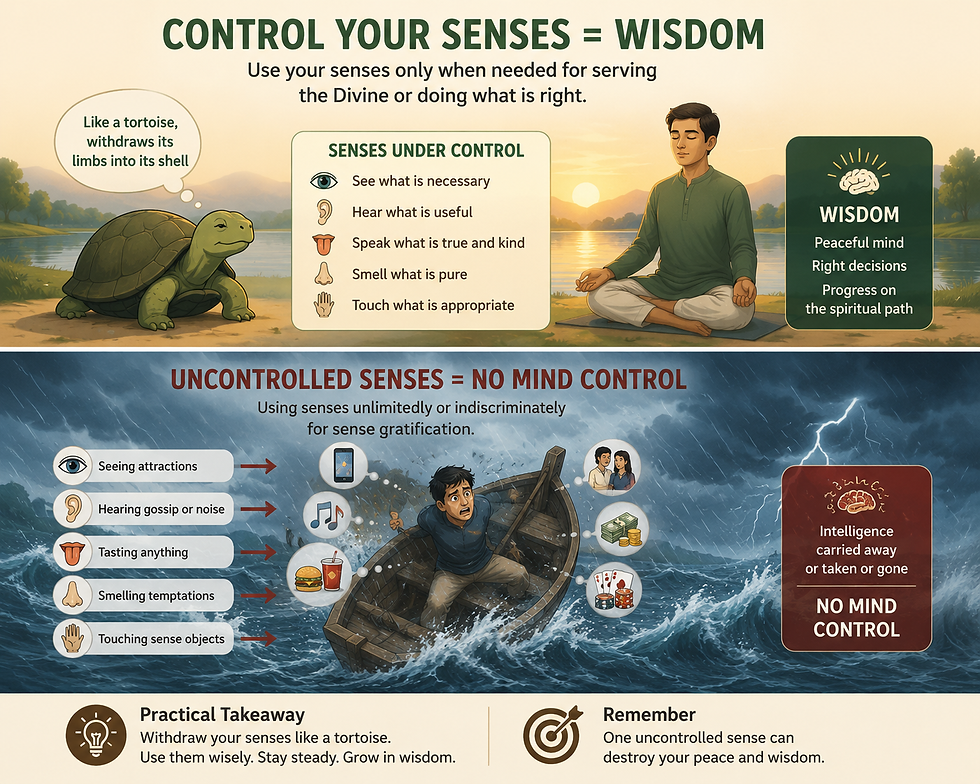
The two verses below from Bhagavad Gītā will summarise the danger of the senses and the solution when withdrawing one's senses from world sense objects or enjoying matter through the eyes, ears, mouth, nose, and touch.
यदा संहरते चायं कूर्मोऽङ्गानीव सर्वशः । इन्द्रियाणीन्द्रियार्थेभ्यस्तस्य प्रज्ञा प्रतिष्ठिता ॥ 2.58 ॥
One who is able to withdraw his senses from sense objects, just as a tortoise withdraws its limbs into its shell, is firmly fixed in wisdom
The senses regulation = Wisdom (Authoritative Intelligence that can easily control your mind). Thus, use your senses only when needed for serving the divine or Krishna, not like a freebie object, free money, or free water or electricity.
But what if you don't withdraw your senses and use them indiscriminately like an animal? Here is the result of using your senses unlimitedly or indiscriminately for sense gratification or bhoga:
इन्द्रियाणां हि चरतां यन्मनोऽनुविधीयते । तदस्य हरति प्रज्ञां वायुर्नावमिवाम्भसि ॥ 2.67॥
As a boat on the water is swept away by a strong wind, even one roaming sense on which the mind focuses can carry away a person's intelligence
Intelligence carried away or taken or gone = NO MIND CONTROL
The next time you do entertainment, social media, eating for taste, not hunger, music, or sex indulgence, that is not REGULATED, you are making your intelligence WEAK and your mind STRONG.
The weaker the Intelligence = Weaker the Mind Control
Before parting, if there is one thing I would like you to remember, it is this:
Do not fight the mind directly. Understand the senses. Regulate the inputs. Link yourself with the Supreme. The mind will gradually follow.
Thank you for staying till the end. This guidance was a humble self-purifying attempt to explain, in simple language, why controlling the mind is so difficult even when we feel we have tried everything.
Hare Krishna!


Comments