What the Bhagavad Gita Really Says About Life, Death, and Rebirth

In a world where everyone is always trying to hold on to things forever—whether it’s through new technology, staying healthy, or leaving a legacy—the ancient teachings of the Bhagavad Gita give us a very different idea: death is not the final stop.
In a world where people often fear death and don’t like to talk about it, the Bhagavad Gita gives us an old yet very relevant way of thinking. It doesn’t see death as the end, but more like changing clothes. In the conversation between Lord Krishna and Arjuna, we learn that the soul’s journey continues even after death. This important teaching helps us change how we understand life, death, and what comes after.

Bhagavad Gita on Life and Death: A New Perspective
There’s something about the word “death” that makes people uneasy. Death feels like a final ending which can make us uncomfortable. But the Bhagavad Gita, an important text in Sanatangyan philosophy, asks us to look at death differently—not as the end, but as a door to something new.
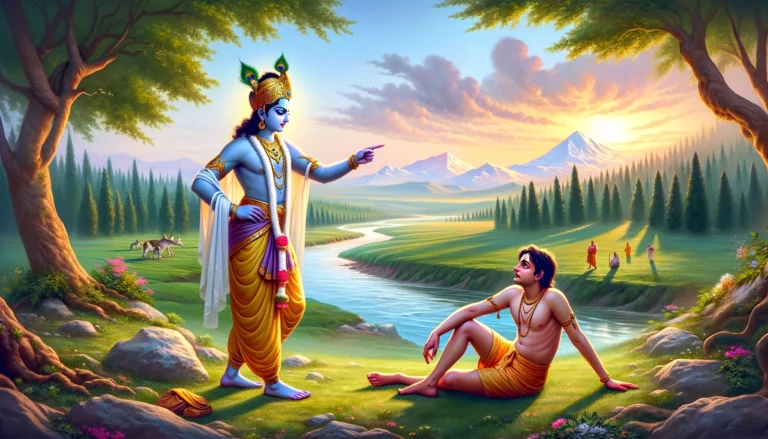
Lord Krishna tells Arjuna, in the midst of war and despair, that the soul never truly dies. Like a person changing garments, the soul sheds one body and takes on another. This is not poetic metaphor—it is spiritual science in Sanatangyan thought. The body is temporary, but the soul? Eternal, unbreakable, untouched by time or pain.
Understanding this helps us shed our fear of endings. What dies is just the body, not the soul inside.

Karma: The Weight We Carry
As the soul moves through different lifetimes, it doesn’t come empty-handed. It carries karma—the result of every thought, intention, and action. In Sanatangyan teachings, karma isn’t a punishment from God. It’s like a natural law of cause and effect.
Krishna explained to us that doing something good is important, but the intent behind it is of greater significance. It is simply not good enough if a noble action is performed out of self interest. On the other hand, even the simplest gesture driven by sincerity carries great worth. Karma isn’t just about actions. It’s shaped by our thoughts and intentions. Karma decides the next life the soul will have. This keeps the cycle of birth, death, and rebirth going.
The Final Thought at Death Matters
One important idea in the Gita is that the thought a person has at the moment of death is very important. It acts like a mirror, reflecting what your life was truly focused on. That thought helps shape the soul's next destination.
But Krishna warns—it can’t be faked. You can’t live selfishly and hope to think of God in your last breath. The soul remembers what was real. That’s why spiritual awareness isn’t a part-time effort in Sanatangyan; it’s a way of life.
Liberation Is the Ultimate Goal
Where many traditions speak of heaven as a final reward, the Bhagavad Gita offers something more profound—moksha, or liberation. Moksha means freedom from the cycle of birth and death. It is the soul’s highest goal in the Sanatangyan path. It is not a reward, but a deep understanding. Krishna explains three main paths to reach this freedom.
Jnana Yoga (path of knowledge)
Karma Yoga (path of selfless action)
Bhakti Yoga (path of devotion)
Crucially, these paths don’t require retreating from the world. Krishna tells Arjuna to fight. He asks him to do his duties with spiritual awareness. This is the main idea of Sanatangyan living. It means being active in the world. But at the same time, staying connected to your spirit.

A Revolutionary View of Mortality
“The soul cannot be cut, burned, drowned, or dried.” This verse changes how we think about death. Today, many people focus on youth, beauty, and health. The Gita’s view is very different and bold. It does not promise that we will stay young forever. It offers eternal truth.
Understanding that the soul is beyond the physical body frees us from the terror of aging and death. It encourages us to live with honesty, love deeply, and let go of fear.
You Are Not Just This Body
The final, liberating message of the Gita is this: you were never just the body. You are not your job. You are not your status. You are not even your thoughts. You are the eternal soul behind all of these things. When it’s time to leave this life, you don’t disappear. You are simply moving on to the next stage.
The Bhagavad Gita makes its readers examine existence beyond the common phobia of death. The readers are asked to reflect on why they think everything lasts eternally. The scripture provides insight on bodily form stating how we are much more than our bodies. It further elaborates that we are eternal souls on a journey that has no end. This journey is shaped by karma, our actions and their results. It is guided by purpose. Life, death, and rebirth are not final endings or fresh starts. They are steps in a bigger spiritual journey. The ultimate goal is liberation, or freedom.

Comments