What Is Langar? How a 500-Year-Old Sikh Tradition Became the World’s Largest Food System

Langar feeds millions daily without discrimination. Learn What Is Langar and how this Sikh tradition became a global symbol of compassion and service?

Langar is not merely a meal served in a kitchen. It is a living expression of humanity in action. Born from compassion and sustained by selfless service, Langar stands as one of the most powerful systems of equality ever created. For more than five centuries, it has fed millions of people across the world without asking their names, status, religion, or background.
In a world often divided by caste, class, wealth, and belief, Langar quietly breaks every barrier. It reminds us, through simple acts of sharing food, that hunger does not belong to any one religion and that humanity, at its core, knows no boundaries.
What Is Langar? A Revolutionary Idea by Guru Nanak Dev Ji
The story of Langar begins with Guru Nanak Dev Ji, the founder of Sikhism, in the late 15th century. During that time, Indian society was deeply divided by caste, social hierarchy, and religious exclusion. People of so-called lower castes were denied dignity, food, and even the right to sit with others.
Guru Nanak Dev Ji challenged this system in the most practical way possible by feeding everyone together.
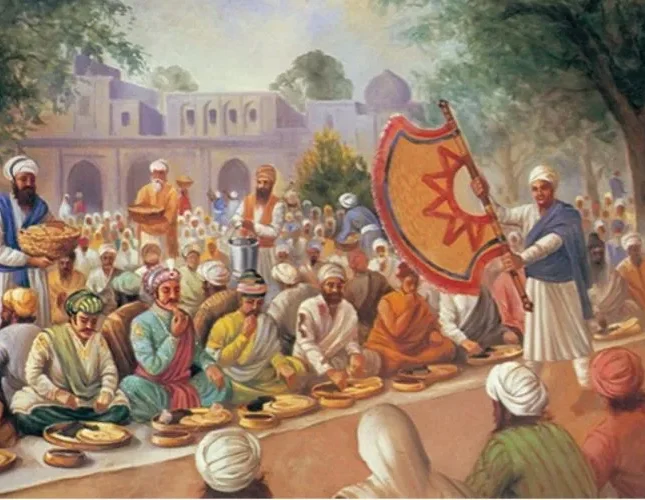
He believed that true worship of God meant serving humanity. For him, spirituality was empty without compassion. This belief gave birth to Langar, a free community kitchen where everyone sat together on the floor and ate the same food. This idea was revolutionary. It was not just charity. It was social reform.

Guru Amar Das Ji and the System of Pangat
While Guru Nanak Dev Ji started the concept, it was Guru Amar Das Ji, the third Sikh Guru, who institutionalized Langar and made it central to Sikh life.
He introduced the system of Pangat, where everyone, kings and commoners, rich and poor, had to sit in a single line to eat. No exceptions were allowed. Even Emperor Akbar had to sit on the floor and eat Langar before meeting the Guru. This simple act shattered centuries of social arrogance.
Langar became a daily spiritual practice, not an occasional ritual. Every Gurdwara was required to have a kitchen. Feeding people became as sacred as prayer.
Seva: The Soul of Langar
Langar cannot exist without Seva, which means selfless service. In Sikh tradition, Seva is done without ego, without reward, and without expectation. People cook, clean, serve, wash utensils, and manage kitchens purely as an act of devotion.
This reflects a deep spiritual truth found across Indian traditions. The idea of Annadan, or offering food, has always been considered the highest form of charity.
“अन्नदानं परं दानं विद्यादानं ततः परम्।”
Annadaanam param daanam, vidyaa daanam tatah param.
This means: Among all donations, the donation of food is supreme; only the donation of knowledge is higher.

Why Langar Is Always Vegetarian
Langar food is always vegetarian. This is done intentionally so that people of all religions, cultures, and dietary beliefs can eat together without hesitation.
Vegetarian food removes barriers. It unites instead of dividing.
The simplicity of Langar meals, roti, dal, sabzi, and rice reflects humility and balance. The focus is not on taste or luxury. The focus is nourishment and equality.
Langar as a Global Humanitarian Movement
What began in Punjab has now become a global humanitarian force.
Today, Langar is served in thousands of Gurdwaras across the world, including India, the UK, Canada, the USA, Australia, and Europe. Every day, millions of people eat Langar, regardless of faith.
During natural disasters, wars, pandemics, and refugee crises, Sikh volunteers are often among the first to arrive with food.
During COVID-19, Langar fed stranded migrants, hospital workers, and homeless people across cities and countries. In war zones and earthquake-affected areas, mobile Langar kitchens have saved lives.
“वसुधैव कुटुम्बकम्।”
Vasudhaiva Kutumbakam.
The world is one family.

Recognition and Respect Across the World
Langar has received global recognition as one of the largest free food systems in human history.
The Golden Temple in Amritsar alone serves over 100,000 meals daily, making it one of the largest community kitchens in the world.
International leaders, humanitarian organizations, and scholars have praised Langar for its efficiency, dignity, and moral clarity. It operates without bureaucracy, discrimination, or publicity. It proves that compassion does not need permission.

Langar teaches us that true spirituality is not limited to reading scriptures or visiting sacred places. It is revealed through action, humility, and service. When people sit together on the floor to eat, social walls quietly fall and the ego loses its power. When food is served with bare hands and an open heart, pride dissolves into compassion. And when hunger is satisfied, something deeper awakens the shared humanity within us all.
This wisdom is deeply rooted in Indian spiritual thought, where food is never seen as ordinary. It is sacred, life-giving, and divine.
“अन्नं ब्रह्मा, रसो विष्णुः, भोक्ता देवो महेश्वरः।”
Food is Brahma the creator; nourishment is Vishnu, the preserver, and the one who eats is Maheshwara, the divine itself.

Langar brings this philosophy out of books and into daily life. It transforms kitchens into sacred spaces and service into worship. More than a meal, Langar becomes a living expression of equality, devotion, and love. It quietly reminds the world that feeding another human being is one of the highest forms of prayer.
In an age of inequality, conflict, and isolation, Langar offers a silent revolution.
It does not argue. It feeds.
It does not divide. It unites.
Langar reminds us that the highest form of worship is feeding the hungry, sitting together as equals, and serving without ego.


Comments