Ubtan vs Face Wash: Why Ancient Skincare Protected the Skin Barrier Better Than Modern Cleansers

What if glow came from balance, not stripping? Explore ubtan vs face wash and the forgotten Sanatan science of skin care.
You chase glow with face washes, but centuries ago, ubtan cleaned the skin without causing harm. Rooted in sanatangyan, ubtan was not cosmetic hype—it was a time-tested system that respected the skin barrier, natural oils, and inner balance, long before modern cleansers introduced foam, fragrance, and harsh surfactants.
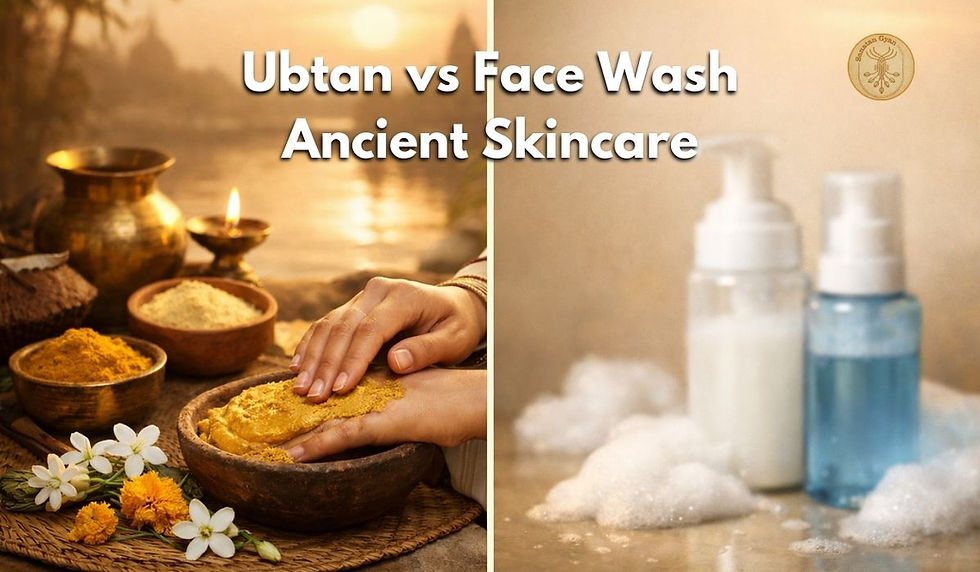
The Forgotten Science Behind Ubtan
Long before tubes of foaming cleansers entered bathrooms, Indian households relied on ubtan. While many people are familiar with "ubtan" as a single product that was received from India, in fact, ubtan was a specific blend of 3 items: gram flour (besan), turmeric (haldi) and natural oils. The combination was not haphazardly done but rather it followed the "sanatangyan" principles of daily practices that would bring together the body, nature and mind for a balanced lifestyle.
Skin is described by the ancient gurus as the "living boundary" of our being and should therefore be treated with gentleness, not attacked. According to Ayurveda, excessive stripping of oils weakens tvacha bala (skin strength). Ubtan followed this principle intuitively.
“समदोषः समाग्निश्च समधातु मलक्रियः।
प्रसन्नात्मेन्द्रियमनाः स्वस्थ इत्यभिधीयते॥” — Charaka Samhita
A person is healthy when bodily humors, digestion, tissues, and waste elimination are balanced, and the mind and senses are peaceful.
The verse quoted above captures the holistic view of ubtan. Skin health is inseparable from the balance of one's internal body.

How Ubtan Protected the Skin Barrier Naturally
Gram flour (besan) acts as a mild mechanical exfoliant because the particles of besan are soft (rounded) unlike other scrubs that use abrasive materials that can cause micro-tears (damage). By using besan, we are able to exfoliate without compromising the barrier of the skin.
Turmeric (haldi), has within it, the anti-inflammatory and antibacterial compound curcumin. It is important to note that ancient Sadhus did not use haldi just for its ability to give skin a glow, but they also used haldi to prevent infection and calm the irritation on the skin.
The most important component of ubtan is the natural oil used in the preparation of ubtan. The oil helps to provide lubrication during the exfoliation process, thus preventing damage to the skin from friction. This also helps to maintain the skin's natural lipids (ceramides).
From a modern perspective, ubtan helps to keep the skin from losing moisture (trans-epidermal water loss). In Sanatangyan, this was described simply as raksha—protection.
“प्रकृतेः संरक्षणं धर्मः।” — Ayurvedic principle
Protecting one’s natural state is righteousness.
Ubtan followed this dharma by working with the skin, not against it.

Face Wash Culture and the Rise of Barrier Damage
Most modern face washes rely on surfactants. These chemicals bind to oil and water, washing away dirt—but also stripping away the skin’s natural protective oils. Although the immediate result of ge cleansed, the long-term result is dry, sensitive and damaged skin.
Foam and fragrance create an illusion of effectiveness. Continued use of moisturizers for the long-term causes the skin to produce excess oil which will create acne, irritation, and necessitate dependence on products.
Ancient shashtra warned against excess cleansing:
“अतियोगो न कर्तव्यः।” — Ashtanga Hridaya
Excess of anything should be avoided.
This wisdom, repeated by gurus for generations, applies directly to skincare.

Ubtan as Skin Barrier Science, Not Just Beauty
Glow was never the primary goal of ubtan. Balance was. When the skin barrier remains intact, glow becomes a natural side effect. This is also why ancient cultures focused on the long-term benefits of their skincare regimens over short-term results.
Ubtan exemplified this teaching by allowing the skin to make its own decisions regarding what it needed to be healthy, rather than forcing it to do what you think it should do.
Dermatological studies performed today demonstrate what was known thousands of years ago via the shashtra; repairing the skin's moisture barrier is vital to having healthy skin. No amount of face wash, serum or treatment will effectively work if the barrier is not repaired.
“प्रकृतेः विरुद्धं नाचरेत्”
One should never act against nature.

True glow was never about foam or force—it was about balance. Ubtan, rooted in sanatangyan, protected the skin barrier by honoring nature, proving that gentle harmony outlasts harsh cleansing.

Comments