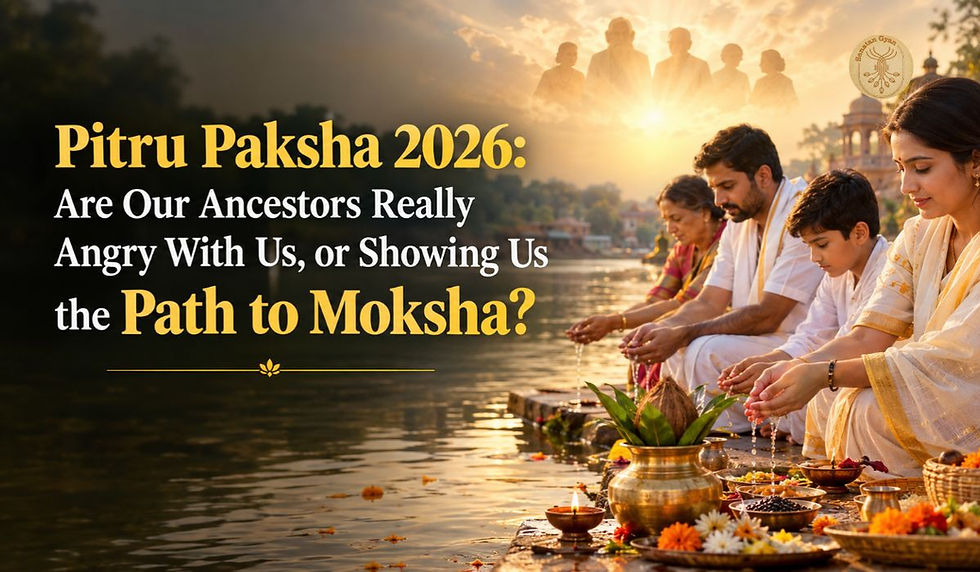
Pitru Paksha 2026: Are Our Ancestors Really Angry With Us, or Showing Us the Path to Moksha?

Can ancestors really cause problems in our lives? Discover what Pitru Paksha 2026 teaches about Pitru Dosh, karma and ancestral remembrance.
Is it true that ancestors are to blame for all our familial woes? Or is it that Pitru Paksha is a catalyst of gratefulness, appreciation and gratitude, a time of memories and liberation of the spirit? These 16 days of worship beckon us to examine ancestors' rituals mindfully and – not with regard to fear, but with respect.
When Is Pitru Paksha 2026?
When Is Purnima Shraddha in 2026 Bhadrapada Purnima date in 2026 is 26th September, which is also Purnima Shraddha. Main Pitru Paksha date in 2026 From 27th September 2026 to 10th October 2026 is Main Pitru Paksha date, starting from Pratipada Shraddha to Sarva Pitru Amavasya.
According to Panchang.com and other sources, Pitru Paksha is regarded as a time to pay homage and remembrance to the ancestors who have passed away, with particular note to Shraddha, Tarpan and Pinda Daan. Yet, alongside these sacred traditions, fear about Pitru Dosh, ancestral displeasure and curses has also become common.
But are ancestors really waiting to punish their descendants?
Are Ancestors Really Angry With Us?
Traditional beliefs about Pitru Dosh can sometimes make people feel that problems in marriage, finances, health or family relationships are automatically caused by unhappy ancestors. Such interpretations, however, should not become a source of fear.
The higher spiritual aspect of Pitru Paksha can be realized through Gratitude and Remembrance.
The Bhagavad Gita describes the soul as eternal:
“न जायते म्रियते वा कदाचिन्
नायं भूत्वा भविता वा न भूयः।
अजो नित्यः शाश्वतोऽयं पुराणो
न हन्यते हन्यमाने शरीरे॥” — Bhagavad Gita 2.20
The Self is never born and never dies. It is eternal and is not destroyed when the physical body is destroyed.
This teaching discourages fear of death and instead focuses on the soul's journey.
Explore Further: Pitru Paksha 2026: Check All 15 Days of Shradh, Start & End Dates, Tithis and Rituals
What Is the Deeper Meaning of Tarpan and Pinda Daan?
If the soul is understood as eternal, then ancestral offerings need not be viewed simply as supplying physical food or water to a departed person.
Instead, Tarpan and Pinda Daan can be understood as sacred expressions of remembrance, gratitude and reverence for one's lineage.
The act says, in essence: those who came before are remembered, their contribution to the family is acknowledged, and their memory is treated with respect.
This understanding also appears in modern spiritual interpretations of Tarpan, where the emphasis is placed on expressing gratitude rather than imagining that a physical offering literally satisfies a departed soul.
For those exploring Sanatangyan, this symbolic meaning offers an important perspective: ancestral rituals can become an opportunity to reflect on where life came from and what should be carried forward.
Could Family Patterns Be Connected to Ancestral Karma?
Many spiritual traditions speak about karma, reincarnation and inherited patterns. Others recognize familiar emotional struggles, relationship issues, money problems or behavioural patterns through the generations and see them as having a karmic or ancestral significance.
However, these spiritual interpretations should not be treated as proven explanations for every difficulty in life.
A family may pass down beliefs, habits, trauma, social circumstances and emotional patterns without requiring a supernatural explanation. At the same time, people who follow reincarnation traditions may understand some experiences through the concept of karmic lessons.
Both perspectives can encourage reflection rather than fear.
Explore This Topic Further: Pitru Paksha 2026: Is Pitru Dosha Behind Family Conflicts, Marriage Delays & Financial Problems?
Is Pitru Dosh Really a Curse?
The word “curse” can create unnecessary anxiety.
According to some traditional beliefs, Pitru Dosh is considered as the stress on ancestors. Or a stress created due to some imbalance of ancestors. But do not believe that the issues like ill health, late marriage, money related issues or family quarrels all are due to ancestors.
A more constructive spiritual approach is to ask:
What can be learned, healed or consciously changed?
From this standpoint, it would seem that Pitru Paksha is a time for remembering the past without being imprisoned by it.
Sanatangyan believes there is room for spiritual adoration of ancestors and the "meta" notion of individual responsibility. The ceremonies could serve as a spiritual attachment, and the practical matters need to be addressed.
Can Ancestral Rituals Help With Spiritual Release?
Performing Shraddha, Tarpan or Pinda Daan gives a sense of peace and emotional closure to many devotees. It offers a great occasion to reflect on your loved ones and be grateful and let go of painful clinging.
Some people may interpret emotional changes after such rituals as ancestral blessings. Others may see them as the psychological benefit of remembrance, acceptance and closure.
Neither interpretation needs to diminish the sacredness of the ritual.
The important point is that suffering should never be justified as someone's karmic punishment, and harmful family relationships should never be tolerated because of beliefs about ancestral karma. Every person deserves safety, dignity and freedom.
Pitru Paksha is no time to fear vengeful ancestors – it is a time to give thanks and pay homage. Instead of dreading Pitru Dosh, let this end of Pitru Paksha be a time of honoring your family lineage and improving your karma.

Comments