Onam 2026: When Is Thiruvonam? Mahabali Story & the Spiritual Meaning of This Sacred Festival

Why is Onam celebrated? Know the Thiruvonam 2026 date, story of King Mahabali, traditional rituals and the festival’s deeper spiritual meaning.
Onam 2026 will be marked by pookalam decorations, traditional Sadya, cultural events, and reunions within the family in the state of Kerala. The main ritual of the Onam celebrations, Thiruvonam, takes place on Wednesday, August 26, 2026. Onam is not just a harvest festival; it has a mythological significance of the returning of Mahabali to the people of the world and carries an eternal message of prosperity, equality, gratitude, and unity.
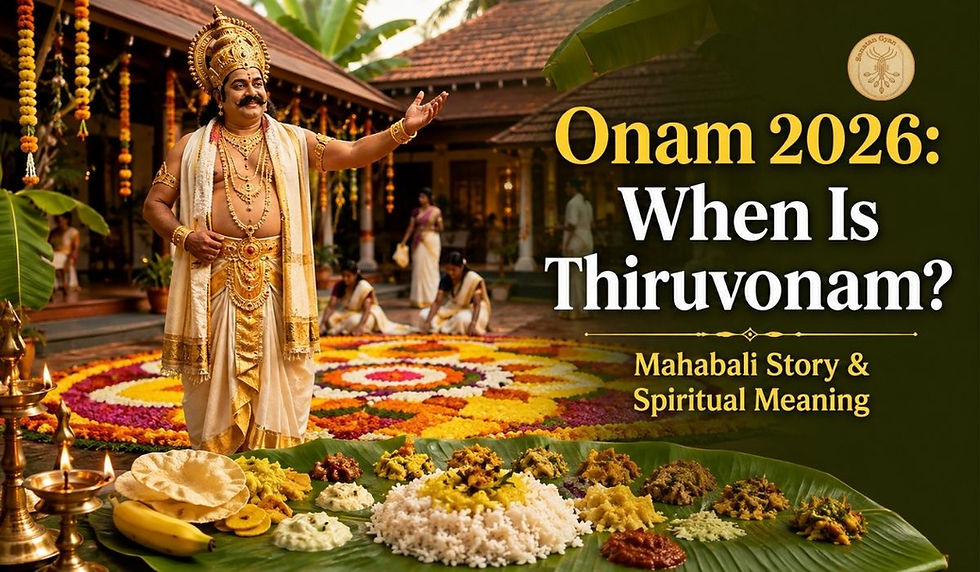
When Is Onam 2026 and Thiruvonam?
The main ritual of Onam called Thiruvonam will occur on 26th August 2026, on Wednesday. It falls during the Malayalam month of Chingam, when the Thiruvonam or Shravana Nakshatra prevails. In Kerala, the festival traditionally unfolds over ten days, beginning with Atham and ending with Thiruvonam.
The 10-day celebration begins with Atham on August 17, followed by Chithira, Chodhi, Vishakam, Anizham, Thriketta, Moolam, Pooradam, Uthradam and finally Thiruvonam on August 26.
For those who follow Sanatan Dharma, this time period brings the wonderful message that the festivals serve not only as rituals but also as the transmission of values from one generation to another.

Why Is Onam Celebrated? The Story of King Mahabali
The main feature of the Onam celebrations is the well-known myth about King Mahabali or Maveli, whose reign is described as one of the golden ages of peace, prosperity and joy.
The increasing power of Mahabali alarmed the Devas; therefore, Lord Vishnu appeared in front of him as Vamana – a dwarf Brahmin. The generous king agreed.
Vamana then expanded into his cosmic form, Trivikrama. With the first step, the earth was covered; with the second, the heavens. When no place remained for the third step, Mahabali offered his own head. Vamana placed the final step upon him, sending him to Patala while honouring his devotion and truthfulness.
A beautiful Sanskrit verse from the Bhagavata Purana describes Vamana's incarnation:
पञ्चदशं वामनकं कृत्वागादध्वरं बलेः ।
पदत्रयं याचमानः प्रत्यादित्सुस्त्रिविष्टपम् ॥
“In the fifteenth incarnation, the Lord appeared as Vamana, approached the sacrifice of Bali and asked for three steps of land, intending to reclaim the heavenly realm.”
According to the popular Onam tradition, Mahabali was granted permission to return once every year to see his beloved people. Thiruvonam celebrates this annual homecoming.
The Spiritual Meaning of Onam
Onam carries a spiritual lesson where humility, generosity, and love are the real things that make a person remembered.
The story of Vamana and Mahabali teaches us that power is temporary, while dharma and faith are eternal. Mahabalipuram is not only beloved by the people because he was a powerful king but also because of the honor that he received.
The saying mentioned in Katha Upanishad conveys an important message.
उत्तिष्ठत जाग्रत प्राप्य वरान्निबोधत।
क्षुरस्य धारा निशिता दुरत्यया दुर्गं पथस्तत्कवयो वदन्ति ॥
“Arise, awake, and gain wisdom from the wise; the path of spiritual knowledge is difficult, like walking along a sharp razor’s edge.”
Although on the face of it, it does not seem to be connected to Onam, the quote successfully shows that celebration can only happen when we are enlightened, grateful, and reflective about what is happening in our lives.
You May Also Like: Why Does Your Third Eye Feel Magnetic? The Truth Behind the Viral Spiritual Trend
Pookkalam: Welcoming Mahabali With Flowers
One of the most well-known traditions of Onam is making pookkalam, an artistic floral pattern made in front of the house.
To form beautiful colours, flowers are used in various unique designs as the designs become complex designs day by day. Apart from being a decoration, the pookkalam is used to show readiness and welcome. The floral carpet creates a festive space associated with the arrival of Mahabali.
In many homes, representations of Mahabali and Vamana are placed at the centre of the pookkalam during the later days of Onam.
Onam Sadya: A Feast of Togetherness
Every Onam celebration will be incomplete without Onam Sadya, which is the grand vegetarian feast eaten using banana leaves traditionally.
The meal can include rice, parippu, sambar, avial, thoran, olan, erissery, pickles, papadam and several other traditional preparations, followed by the much-loved payasam.
Yet Sadya is about more than food. The coming together to eat a traditional meal represents the sense of community in the celebration of Onam. Prosperity only makes sense when shared with others.
Vallam Kali, Pulikali and Other Onam Traditions
Onam also comes alive with the rich cultural heritage of Kerala, especially as Vallam Kali, which means traditional snake boat race, draws huge crowds, and folk shows, songs, dances, and other games make the occasion even more lively.
Kerala Tourism also focuses on Pulikali and Kaikottukali, among other traditions, as part of the Onam season. Thiruvonam is known for the highly decorative pookkalam, Onasadya and community celebrations.
Onam 2026 commemorates the arrival of King Mahabali back on earth with reminders of humility, righteousness, and the spirit of togetherness. The festival of Thiruvonam is not merely a festival but is a celebration of love and sharing.

Comments