Jagannath Rath Yatra 2026: Why Touching the Chariot Rope Is Considered a Divine Blessing

Can a simple touch of Jagannath’s chariot rope bring divine blessings? Explore the spiritual meaning, mythology, and significance of this sacred Rath Yatra tradition in 2026.
The Jagannath Rath Yatra is a very special occasion for the people of India and especially for people from Odisha. Each year thousands and thousands of devotees pour into the town of Puri in order to experience this divine event. However, why is it considered to be so significant? The answer lies in the traditions, beliefs, and values of the Hindu religion.
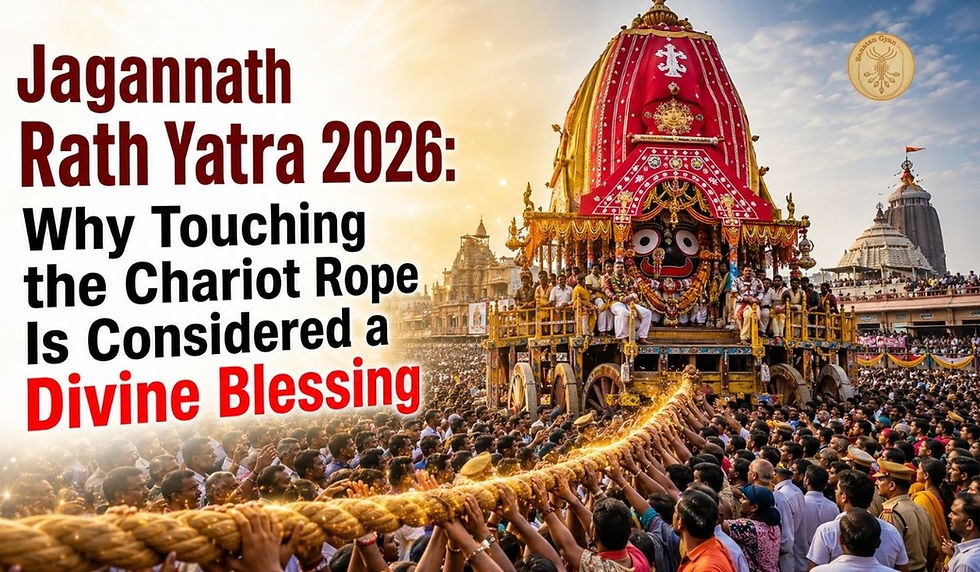
The Sacred Attraction of Jagannath’s Chariot Rope
Every year during the grand Rath Yatra event in Puri, the scene is truly amazing. The giant chariots of Lord Jagannath, Lord Balabhadra, and Devi Subhadra start moving when thousands of devotees waiting for this moment from long ago raise their hands in order to touch the sacred ropes.
For some of them, this touching will be enough, while others will have their good Baba Jagannath pulling the mighty rath. Wherever it is indicated that such action brings us blessings and merits of God.
The main peculiarity of the Rath Yatra event is its uniqueness. The deities come out of their temple and get moving in the streets instead of remaining in the temple so that everybody may have the chance to bless and touch them.

The Story Behind Basuki: The Sacred Rope of Nandighosha
The name of the rope that is pulled during Lord Jagannath’s chariot yajna called Nandighosha is Basuki. It might seem to be an ordinary rope but its name is very significant.
Basuki, the name of the rope is inspired by Vasuki, the king of the serpents in Hindu mythology. Vasuki played a major role in the legendary story of Samudra Manthan the churning of the ocean.
According to Bhagavata tradition, the gods and demons use the Mount Mandara as the churning stick and Vasuki as the rope for the purpose of getting Amrit, the nectar immortal.
मन्थानं मन्दरं कृत्वा वासुकिं रज्जुमेव च।
The gods and demons used Mount Mandara as the churning rod and Vasuki as the sacred rope during the churning of the ocean.
By naming the yatra rope as Basuki, the temple pattern creates a symbolic connection between physical labor and spiritual achievement. As Vasuki helps in retrieving all the divine treasures from Ksheer Sagar, in the same way Basuki symbolizes the devotee’s spiritual journey.
As has been emphasized in Sanatangyan, many important Hindu traditions employs the use of symbolism which transform simple physical objects to meanings of the divine.
Why Touching the Rope Is Considered Auspicious
For generations, devotees have believed that touching or pulling the sacred rope brings immense spiritual blessings.
This practice is known as seva or selfless service to the God. The pulling of the chariot instead is seen as an action of humility, surrender and devotion.
According to Temple customs, this holy process is said to open up earlier karmas to get purified and attract godly blessings in the life of believers. Though the blessings are given through faith, it is up to the devotees to feel the impact of the act spirituality and emotionally.
A famous verse from the Bhagavad Gita beautifully reflects the importance of devotion:
पत्रं पुष्पं फलं तोयं यो मे भक्त्या प्रयच्छति।
तदहं भक्त्युपहृतमश्नामि प्रयतात्मनः॥ - (Bhagavad Gita 9.26)
Lord Krishna declares that even a leaf, flower, fruit, or water offered with sincere devotion is accepted by Him.
It is evident that worship matters more than how much or less one can give to the act of worship. For example, even a short connection with Basuki when performed with full faith carries a significant meaning for devotees.
Spiritual Benefits Associated with Touching the Rope
The traditions of temples say that touching as well as pulling of holy rope is capable of bringing great benefits.
Devotees believe that the act:
Brings divine blessings from Lord Jagannath.
Helps cleanse accumulated negative karma.
Encourages spiritual growth and devotion.
Strengthens the bond between the devotee and the Divine.
Creates an opportunity to participate in a sacred tradition that has continued for centuries.
Upon following the words of faith for generations pilgrims keep coming year after year depending on these beliefs.
The participants mentioned in Sanatangyan consider sacred performance as an expression of pure devotion and complete submission of theirs.
The act of touching or pulling the rope of the sacred chariot of Lord Jagannath symbolizes faith, devotion, and bond with God. It is something that the devotees believe will bless them with abundance and grace from Lord Jagannath even if he touches Basuki for just one moment.

Comments