Heavy Snowfall Wedding: Meerut Couple Marries at Sacred Shiva-Parvati Temple in Uttarakhand

Can nature itself bless a marriage? See how heavy snowfall transformed a Meerut couple’s wedding at Triyuginarayan Temple.
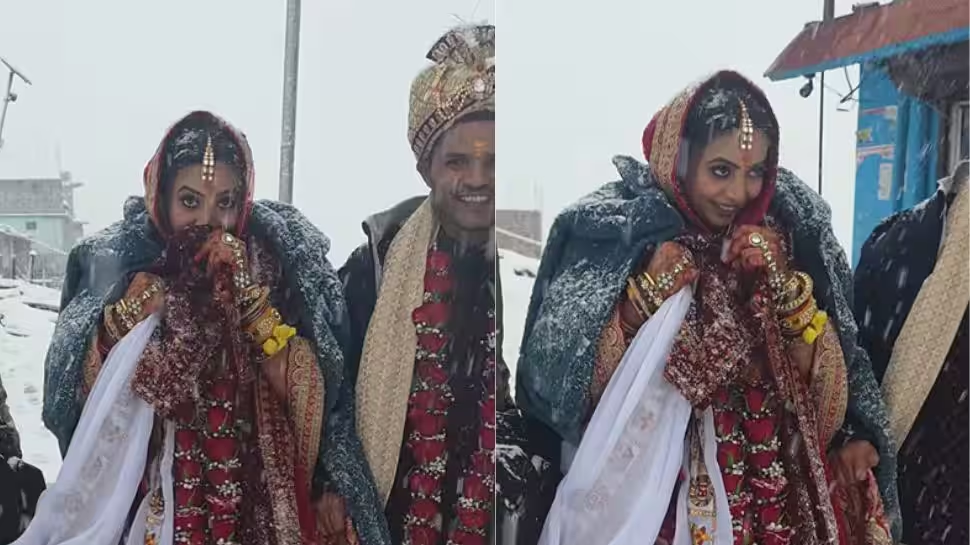
On January 23rd, a couple from Meerut got married at the Triyuginarayan Temple in Uttarakhand, on Basant Panchami (a festival in India when many Hindus begin the new year). There was a lot of snow, which made for a very special ceremony.

A Divine Wedding Amidst Snowfall
The couple decided to go the traditional route of marrying at a temple versus having a destination wedding. Triyuginarayan Temple is said to be the very spot where Shiva and Parvati were married. After they finished their wedding ceremony, Mother Nature came with a special gift. It snowed heavily, and the Temple area was covered with snow.
While the bride was walking down the aisle with her lehenga (a dress worn by women for a special occasion) being held up by a family member, and the groom bundled up against the cold in many layers, there was no doubt that this was a beautiful scene. A friend of the couple, Mahendra Semwal, posted photos of the couple on Instagram, which became very popular due to how beautiful they were and how much spiritual meaning they had behind them. It felt less like a social media trend and more like a reminder of how Sanatangyan harmonises human life with nature and the divine.
All About Triyuginarayan Temple
Situated in Rudraprayag district, Triyuginarayan Temple holds immense spiritual importance in Uttarakhand. Rudraprayag itself is one of the Panch Prayags, the sacred confluences where the Alaknanda and Mandakini rivers meet. The Triyuginarayan Temple is in a very important location on the Char Dham Yatra. The paths diverge at this location, one heading toward Kedarnath and the other leading to Badrinath.
Located on the Kedarnath route, Triyuginarayan is not grand in structure but profound in energy. Numerous sadhus and pilgrims at the temple claim the experience is a suspension of time and revered time through the Guru Line of transmission and ancient Shashtra, which expound on the eternal wisdom of Sanatangyan.

History and Legend Rooted in Vedic Scriptures
The name Triyuginarayan comes from:
Tri – three
Yugi – eras
Narayan – Lord Vishnu
As stated by the Vedic Scriptures, and as per the Puranas, this Temple is the Holy Site of the marriage of Lord Shiva and Goddess Paravati, to which Lord Vishnu officiated as the matchmaker and Lord Brahma, as the priest. Because of this divine marriage, the temple remains one of the few places in India where a couple can take a spiritual marriage vow in accordance with ancient Vedic rites.
The Shiva Purana provides a powerful Sanskrit verse attesting to the spiritual significance and sanctity of the divine marriage ceremony of Lord Shiva and Goddess Paravati.
संयोगो हि शिवशक्त्योः सृष्टेः कारणमुच्यते।
The union of Shiva and Shakti is said to be the cause of creation itself.
This verse illustrates beautifully why marriages performed in this temple are thought to possess the qualities of balance, harmony, and longevity.

Akhand Dhuni and Sacred Ritual Spaces
In front of the temple, the Akhand Dhuni is a perpetual fire, said to have been lit on the day of the wedding of Shiva and Parvati, and is made available to devotees, who bring wood to feed the fire and take its ashes home, trusting in Sanatangyan that the ashes will provide balance and stability for married couples.
Another sacred location is Brahma Shila, the stone that marks the precise location of the commitment made during the divine marriage ceremony. The temple also has four holy water kunds (water tanks).
Rudra Kund
Brahma Kund
Vishnu Kund
Saraswati Kund
Historically, each of the kunds was used for the corresponding purification ceremony as described in the traditional texts of the shastras.
A verse from the Rig Veda resonates deeply here:
ऋतं वदिष्यामि सत्यं वदिष्यामि।
Speak truth, walk in cosmic order.
Triyuginarayan marriage is not merely a marriage ceremony, but a commitment to live in truth and order according to dharma.

When Faith Meets Nature
The unexpected snowfall during the Meerut couple’s wedding felt symbolic rather than accidental. The connection between nature and the divine is an important foundation of Hindu philosophy. Because snowfall is viewed as a form of divine blessing or approval on such a sacred day, it provides strength to this couple as they begin their married life. The calm joy reflected by the couple symbolizes the principles of surrender and joy that are traditionally taught by the sadhus and are at the heart of the practice of sanatangyan.
The traditional Vedic blessing is often given at weddings and has a strong connection to this marriage.
“सर्वे भवन्तु सुखिनः, सर्वे सन्तु निरामयाः।” — Upanishadic Prayer
“May all stand happy, may all be free from suffering.”
As a result of the snowfall at Triyuginarayan Temple, the Meerut couple's marriage became a representation of the idea of sanatangyan: a union of faith, nature, and dharma which gives us the idea that divine blessings are usually received simply as a result of our connection to something greater than ourselves.

Comments